National Collegiate
Grappling Association
Register
About Events Rankings Teams News Rulebook Start a team

Start a program

Request a Team

Register as

Athlete Coach Official Team Admin
Table of contents

I. Governance & Organizational Structure

Membership

1.1 Regulatory Authority

The National Collegiate Grappling Association (NCGA) was organized in 2013 to promote, support, and regulate grappling at the college and university level. The member schools give regulatory authority to the NCGA as a National Governing Body (NGB). Institutions of higher learning may apply for membership through the NCGA Board of Directors. All junior colleges, accredited trade schools, colleges, and universities, both private and public, are eligible for membership in the National Collegiate Grappling Association

The President, CEO and Executive Director, along with appointed officers and committees organized under the purview of the NCGA Board of Directors, and the Judicial Council, function to provide the administration, regulation, and promotion of amateur grappling at the college level for all member institutions.

1.2 Eligibility of Schools

Membership in the NCGA is open to all accredited institutions of higher education. Member teams are generally chartered under the jurisdiction of the Athletic Department, the Sports Activity Coordinator, Sport Club department or any department granted the administrative authority by the member institution. Institutions may sponsor only one men’s and one women’s NCGA-governed grappling program during any season.
All teams, coaches, athletes, and member institutions agree to adhere to the rules and regulations set forth herein. Any act of deceit or willful and calculated disregard of any portion of the NCGA Rules and Regulations and/or the NCGA Codes of Conduct may result in the suspension of any NCGA member school. Any act intended to circumvent any rule or evade penalty by the NCGA may be treated as though said rule violation occurred.

1.3 NCAA Eligibility of Schools

The NCGA functions only as an organizational body and does not accept any liability for athletes during practice, travel, or competition. Athletes and Teams must be insured by the liability coverage of their respective school. Most programs are automatically covered by their officially recognized school status. All athletes are required to carry personal health or injury insurance coverage. In addition, the NCGA may choose to carry liability and or injury insurances and, at its discretion, cover member athletes and institutions.

1.4 Membership of New Schools/Programs

New schools may apply for membership in the NCGA by first contacting the NCGA at 469-879-1400 or by email at [email protected]. Upon making initial contact with the
NCGA, the Director of respective division (Men’s or Women’s), if any, or appropriate NCGA official shall send the prospective member a “New Team Application.” After the New Team Membership Application is received by the NCGA in good order, then ‘due diligence’ will be performed to verify the information and clarify any questions or concerns with the administration of the applying institution.

Once accepted, new programs will be assigned to a NCGA Conference by geographical location as per Articles 2 and assessed by the respective Conference a Conference fee.

1.5

Annual Membership for Current School Members

All actively participating member schools must complete the NCGA team membership process each year. The Team Membership Application is available on the NCGA website.

1.6 Membership Classifications

NCGA Minimum Membership requirements are determined by the NCGA Board of Directors and commissioned officers.

  • NCGA Men’s Division
  • NCGA Women’s Division

1.7 Gaining Full NCGA Membership

After a team’s initial (referred to as provisional) year in the NCGA, they are automatically moved to full membership in their respective division provided they comply with all NCGA eligibility and competition rules as well as adhering to NCGA best practices. For Men's and Women's Programs to gain full membership they must have an NCGA-approved / accepted non-student coach providing consistency in training and leadership from year to year.

Teams that are reprimanded during a season for non-compliance with NCGA rules or those that do not have a non-student coach may be required to serve additional provisional years. Continued rule violations may result in probation and dismissal from the NCGA for a year or more. Waivers for the non-student coaches’ criteria may be granted by the conference for extraordinary circumstances such as loss of a previously registered non-student coach late in the season.

1.8 Losing NCGA Membership

The Judicial Council may rule that teams be suspended or forfeit membership in the NCGA through serious or repeated violations of the NCGA Rules and Regulations, or automatically after two years of past due Association Membership dues

Composition of NCGA

2.1 Conference Alignment

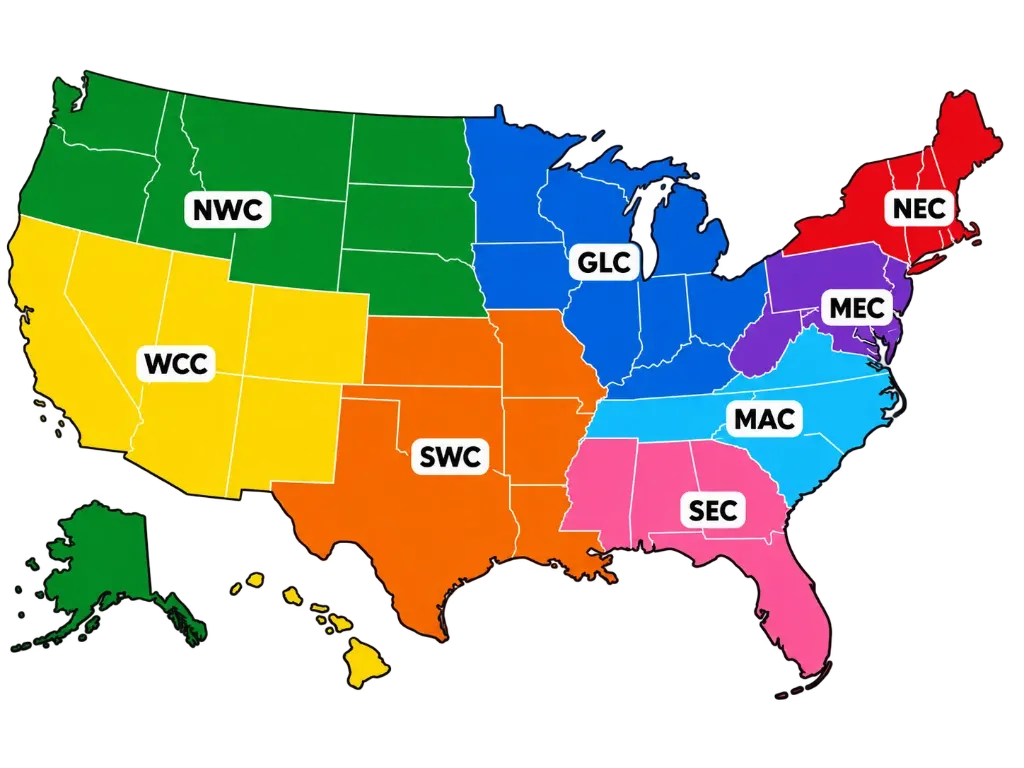
The NCGA is divided into eight (8) Conferences aligned geographically as follows. Teams must be a part of a NCGA Conference in order to qualify for the National Championships.

  1. Great Lakes Conference (GLC) Illinois, Indiana, Iowa, Kentucky, Michigan, Minnesota, Ohio, Wisconsin, Ontario (CA)

  2. Mid-Atlantic Conference (MAC) North Carolina, South Carolina, Tennessee, Virginia, West Virginia

  3. Mideast Conference (MEC) Delaware, Maryland, New Jersey, Pennsylvania, Washington D.C.

  4. Northeast Conference (NEC) Connecticut, Maine, Massachusetts, New Hampshire, New York, Rhode Island, New Foundland (CA), Quebec (CA)

  5. Northwest Conference (NWC) Alaska, Idaho, Montana, North Dakota, Oregon, South Dakota, Washington, Wyoming, Alberta (CA), British Columbia (CA), Saskatchewan (CA)

  6. Southeast Conference (SEC) Alabama, Florida, Georgia, Mississippi

  7. Southwest Conference (SWC) Arkansas, Kansas, Louisiana, Missouri, Nebraska, New Mexico, Oklahoma, Texas

  8. West Coast Conference (WCC) Arizona, California, Colorado, Hawai’i, Nevada, Utah

NCGA Conference Alignment Map

2.2 Conference Realignment

An established program in the NCGA may apply for membership in a conference other than their geographical conference as provided on NCGA website that is contiguous to their Conference’s boundary.

  1. This must be approved by the Chairman and the Commissioner of the conference they intend to leave.

  2. They must then apply for membership in the new conference and be accepted by the Chairman and the Commissioner of that conference.

  3. Final approval of the transfer shall be made by the NCGA Board of Directors.

  4. A one-time exit fee shall be paid to their original conference and the program must then pay the current conference fee of the accepting conference that year and moving forward. The exit fee may be waived by the original conference.

  5. A change in the conference is for a minimum period of three (3) years or when the NCGA redraws geographical conference lines.

2.3 New Teams -

New teams, approved for NCGA membership, may elect to join any conference contiguous with the border of the Conference in which they are geographically located.

2.4 NCGA Competition Season

The Official Competition Season shall begin on January 1 and continue through the completion of the NCGA National Championships.

2.5 Pre-Season

Athletes may compete on behalf of the school and the NCGA from September 1 through December 31. Preseason is designed to practice, master technique, to build competition endurance and strength. Events, whether Duals or Tournaments, are not official and will not count on athletes nor team records. Pre-season is “ Practice Season”

II. Athlete Eligibility, Divisions & Categories

Athlete Eligibility

3.1

NCGA athletes are limited to a total of 5 years of competition(consecutive or not) in the NCGA while the athlete is enrolled in an undergraduate or graduate degree program.

3.2

Student-athletes must be enrolled in a minimum of 9 credit hours each semester while competing (6 hours for Graduate students) and maintain a minimum 2.0 cumulative GPA after their first year of eligibility in order to be eligible to compete. Graduating seniors are exempt from the 9-unit requirement if they will complete their graduation requirements at the end of the current semester.

REQUIRED ONLINE REGISTRATION

4.1

Student Athlete Registration begins September 1 of each season, and all Student-Athletes must register online through the NCGA Clearinghouse no later than March 1 of each school year. Only NCGA athletes who have been properly registered and cleared for competition may participate with their team. the NCGA does Not recognize individual or unattached athletes.
All athletes must be directly connected to their university program.

4.2

A student who is enrolled at an NCGA member institution and participates in an open tournament or team competition (dual or individual tournament) after the start of the NCGA season, without being properly registered and cleared for competition with the NCGA, will be subject to immediate suspension from the NCGA up to a time period of the remainder of the season and retroactive to the date of infraction OR a calendar year suspension depending upon the timing of the infraction. Team fines for this violation may also apply.

Note: The suspension of the athlete may be challenged through the judicial council. The final determination of suspension/eligibility of the athlete if challenged will be adjudicated by the NCGA Judicial Council as set forth in this document and is based upon the pertinent facts of each individual case.

4.3

An institution shall not permit any athlete to represent their team in collegiate competition within the NCGA unless that athlete maintains the minimum academic eligibility requirements of that institution. It is the responsibility of the individual grappler, and his coach, to monitor academic status. The NCGA does not track individual academic performance, however, will uphold the academic institution’s decisions regarding eligibility if the standards are higher than that set forth by the NCGA.

4.4 Academic Eligibility for Conference and Nationals

To compete in the Conference Championships, an athlete must have a Cumulative Overall Grade Point Average (GPA) of 2.0 or better after 1 year of eligibility, as verified by the school’s Registrar on the Academic Eligibility Form. Academic Eligibility forms must be completed each competition season between February 15 and April 1. Forms must be signed and officially stamped by the university registrar attesting to a students academic status. Once completed, the team admin must upload the forms to the teams web page and secure the original forms to be taken to conference and or Nationals as appropriate.

4.5

To certify eligibility, all Student-Athletes must register online with the NCGA Clearinghouse. Only properly registered athletes are eligible to compete on, or for, any NCGA member institution during the competition season. No athlete may practice, compete, or travel in any NCGA event until their online Individual Athlete Registration and their Waiver and Release of Liability have been properly completed, submitted, and received by the NCGA. The deadline for submitting the online Individual Athlete Registration is March 1 of each season. A critical part of registration requires a clear, professional headshot photo of each athlete for identification purposes and to print the athletes membership card and event credentials.

4.6

Any NCGA team that enters an ineligible athlete in a competitive event during the season will be sanctioned according to their Conference Board. Additional penalties may be determined for the Head Coach and/or coaching staff for the violating team including but not limited to suspension for a time period determined by the Judicial Council. Additional violations may result in additional sanctions and fines, including but not limited to, a team being banned from competition within the NCGA for a calendar year or longer as determined by the Judicial Council.

Divisions

Division 

Experience level

Rules 

Match time 

Division 1

Advanced

All traditional submissions No heel hook, no knee reaping

5

Division II

Beginner

All traditional submissions No heel hook, no knee reaping

5


Weight Classes

6.1 NCGA Weight Classes

Weight categories for male and female are as follows:

MALE 128 139 150 161 172 185 198 220 285
FEMALE 115 124 135 147 159 172 185 220

Transgender Student Athletes Policy

  1. Any transgender student-athlete who is not taking hormone treatment related to gender transition may participate in sex-separated grappling activities in accordance with his/her assigned birth sex.

  2. The student-athlete must meet all other requirements to compete in the NCGA, including but not limited to college or university registration status, years of eligibility and minimum academic requirements.

III. Code of Ethics & Integrity Standards

NCGA Staff and Volunteer Responsibilities

8.1

All members of the NCGA event staff, and volunteers are a direct reflection of the NCGA and must be trained by and/or approved by the NCGA. All members are expected to conduct themselves in a respectful manner with professional behavior that reflects pride in partaking in a successful and efficient event. Any person that fails to follow or maintain the image of the NCGA is subject to have membership, certificate, and/or approval suspended or revoked. General responsibilities are as follows:

  1. Report to the event at least one-half hour (30 minutes) prior to the event;
  2. Dress appropriately and in uniform.
  3. Must be focused and engaged in handling duties efficiently and accurately.
  4. Maintain a professional demeanor.
  5. It is prohibited to issue instructions to an athlete while in the competition area. Support can be shown for athletes by sitting in the spectator area.

8.2 Dual Match Scheduling and Hosting

NCGA member schools may host competition ONLY between grapplers and teams that are active members of the NCGA. All in-Season matches will count toward the NCGA records and National NCGA Points if the hosted event was officiated by a Registered Grappling Official representing a recognized sanctioning Officials Association. Events hosted in the Off Season are practice or scrimmage only and shall not count on the athlete's nor schools record for the upcoming season.

Scheduling: 
 All NCGA Member Schools should attempt to offer their student athletes a minimum of 2 dual competitions during pre-season to allow students, coaches, trainers & officials practice seasons in which to become acquainted with rule sets and procedures for the upcoming season Coaches should reach out to other NCGA member teams within a 3 hour drive between August and October to lock down dates of dual competitions. 
all competitions should involve a written competition contract, scheduling a local official and exchanging potential roster lineups.

Hosting: a Dual": The Hosting university oversees the overall planning of the event and makes final decisions regarding any issues pertaining to event organization and progress.  This school event coordinator has supervisory authority over all phases of the dual’s operation, makes assignments where necessary; Ensures that the event is held in a good venue, has all necessary equipment and technology. It is responsibility of the Dual Host to contact NCGA for any questions or guidelines in conducting a successful event.

CRITICAL: At all competitions, the host team must provide a certified trainer and / or EMS staff.

8.3 Hosting a Tournament

As in hosting a Dual,the university oversees the overall planning of a tournament and makes final decisions regarding any issues pertaining to event logistics, organization and progress. The university event coordinator makes assignments where necessary; Ensures that the event is held in a good venue and has all necessary equipment and technology. The host school/coach should appoint a tournament committee having supervisory authority over all disputes and active competition phases of the Tournament. The coordinator and tournament committee works together to ensure that the event stays on-schedule and is efficiently executed. It is responsibility of the host to contact NCGA for any questions, guidelines or help in conducting a successful event.

8.4 Director of Promotion:

The Director of Promotion is responsible for promoting the event to the university population as well as to local newspapers, television, and radio stations. Promotion of events can encompass the use of social media, local media mailers, posters, flyers, newsletters, and invitations. Information on dates, cost, and registration should be visible or accessible to all NCGA member institutions. Director of Promotion should also strive to obtain publicity coverage of the event and is responsible for having an official event photographer present.

8.5 Conducting Weigh-In's

  1. Weigh-in Times and Location for an event must be communicated in writing via posting, email, or text to each competing teams coach no later than 48 hours before the weigh-in.
  2. Weigh-in Times are CRITICAL. Athletes should arrive well before the scheduled time and be prepared to undergo a skin check prior to weigh-in.
  3. Weigh-in Shall begin promptly at the designated and advertised time.
  4. Weigh-in Shall close one hour after the beginning scheduled time and no athlete my weigh-in after the scheduled closing. The Tournament committee may make exceptions for delayed flights, traffic accidents or other events outside the control of the team.

Weigh-In Officials are responsible for competitor weigh-in and ensuring that each competitor is in the proper weight for the registered division, for the event. The competitor is responsible for falling within the registered division weight limit and know their weight dressed in uniform. If the competitor does not meet weight requirements they are automatically disqualified from competition. Weigh-In Officials also have the autonomy to determine disqualification. Weigh-in Data including, Name, School Weight Class and Actual weight should be entered by the official onto a physical weigh-in sheet and signed by the official at the conclusion of the weigh-in

8.6 Head Table Coordinator

The Head Table Coordinator oversees all the work performed by the head table assistants, mat coordinators, and runners to ensure proper and accurate progression of brackets. If tournament is not using an electronic bracket system, the head table assistants are responsible for holding on to and distributing paper bout sheets to each Mat table and returning those bout sheets to the head table.

8.7 Head Table Assistants

Head Table Assistants are responsible for reviewing and updating bracket results provided by the runner from each mat table. All systems must be operating properly, including computers and printers, and bout sheets kept in case of a discrepancy.

8.8 Tournament Director

The Tournament Director coordinates brackets prior to an event to create un-biased and fair matches, adheres to established bracket procedures and ensures that they are accurately followed. If there are any changes, the Bracket Coordinator/ Matchmaker must contact the competitor and coaches regarding any changes or updates.

8.9 Score Keeper/Table Official

The Score Keeper/Table Official must be completely focused during each match to accurately record points and penalties signaled by the referee, make sure that points are displayed on scoreboard, keep match time, and announce the end of the match using a scoreboard buzzer or whistle.

8.10 Tournament Security

Tournament Security guards assist in keeping order of event and ensuring spectator and competitor safety. Tournament Security guards are responsible for performing constant event walk-throughs to ensure that the event main entrance and exit points are not obstructed and that other points of entry and exit are closed.

8.11 Front Table/Check-in

There should be a minimum of two (2) people stationed at the Front Table/Check-in area. Responsibilities are to greet public, communicate spectator fees, collect fees, and stamp hand of each person that has paid for entrance to tournament as a spectator, check-in competitors, check ID, instruct them to bull-pen/warm-up areas, and address any questions that can be handled by front end personnel.  These individuals are to ensure that the cash box is locked, and money accounted for at the end of each tournament day.

8.12 Mat Coordinator

Mat Coordinators receive brackets from the Main Table, summon competitors to the warm-up area, check NCGA IDs, ensure weigh-in before first match, direct competitor to the match area, and follow matches accurately to record results in the bracket.  After a bracket has closed, the Ring Coordinator returns the bracket to the Main Table.  

8.13 Runner

Runners are responsible for supporting event Coordinator with their duties.

Mat Coordinator, Runner, or Weigh-In Inspectors will call for competitors prior to their matches up to three times at warm up area/bull pen, if competitor is non-responsive at that point, they will be called out via the PA system and will then have 5 minutes to report to Ring Coordinator, Runner, or Weigh-In Inspectors. If competitor does not report within the 5-minute mark they will be subject to disqualification.

8.14 Awards Team

The Awards Team is responsible for having medals and trophies displayed and efficiently awarding medals which includes calling and announcing winners to podium, setting competitors in place on podium that is composed of three levels each labeled under 1st, 2nd, or 3rd, and placing medals according to placement. 

8.15 M.C./Announcer

The M.C./Announcer is responsible for the welcome/introduction speech, playing the National Anthem, assists in calling out divisions for weigh-in or check-in, makes announcements throughout the day regarding matches, winners, future events, sponsors, Facebook or twitter page, and general NCGA information.

8.16 Athletic Trainers / Medical Representatives

Medical Representatives operating under the direction of certified athletic trainers must be able to handle injuries that may occur to athletes during competition. Athletic trainers are the final determination as to an athletes ability to continue the competition after stoppage due to injury. Accepted Concussion protocol must be used in the event of any head injury or loss of consciousness.
Representatives must follow proper protocol in cleaning up and properly disposing of any associated medical waste.

8.17 Media/Photographer

The Media/Photographer(s) are responsible for event coverage and are required to make all media available to NCGA.  Individuals seeking an NCGA Press Pass should represent a social media company, magazine, or local newspaper and should acquire NCGA approval three (3) weeks prior to the event to have access inside the competition area.  Media/Photographer(s) shall not interfere with tournament procedures, matches, and/or distract competitors during competition. 

8.18 Referee Director

The Referee Director has supervisory authority over referees and is responsible for ensuring proper training of referees, including knowledge and understanding of the NCGA rules and policies, selecting NCGA certified referees for events, and during an event is responsible for overseeing referee decisions, quality, and fair play.  The Referee Director is responsible for holding a pre-and-post event meeting with referees to review referee roles in competition and to discuss any concerns that occurred during the specific event. The Referee Director guides and issues a technical evaluation of the referees at the end of each competition. In some cases, and upon request, the Referee Director will review details or footage of a specific match and can overturn central referee’s decision as identified in the NCGA Rulebook.

8.19 Referee

The referee has one of the most important roles in a tournament and is responsible for judging each match fairly based on the NCGA rules of competition and declaring the appropriate winner. Only the Referee Director can overturn a referee decision after reviewing details or footage of a specific match. For further details on referee principles and procedures see Chapter VI

Code of Conduct

9.1

It is the responsibility and obligation of all competitors, coaches, officials, administrative personnel, volunteers, members and representatives of the NCGA to practice and demonstrate the highest principles of sportsmanship and to observe the ethics of competition. The display of good sportsmanship is mandatory as it is a statement of the individual’s understanding and commitment to fair play, ethical behavior, and integrity.  Competitors are expected to know and understand the rules of play, be on time, and demonstrate respect for themselves and others.

9.2

Code of Conduct Guidelines for competitors are as follows:

  1. Treat opponents with respect.

  2. Play hard while competing within the rules.

  3. Exercise self-control at all times.

  4. Set a positive example for others to follow.

  5. Before and after the match, competitors must shake hands and referee’s hand.

  6. Respect officials and accept their decisions without argument or gesture.

  7. Win without boasting and lose with dignity.

  8. No self-scoring or self-cheering during the match.

  9. Athletes should proudly represent their collegiate team, and if any, academy team, professor, family, and community.

  10. Athletes must stand at attention during the recognition of the first-place athlete.

  11. Must not be under the influence of any substance.

  12. Must not remove any part of the uniform when inside the competition area.

  13. Must not jump over the barriers that separate the competition area and the public area.

  14. Must leave the competition area/field of play or the space reserved for working officials once matches are completed.

  15. Must not walk barefoot within the competition area or in other areas where shoes are required.

9.3

Code of Conduct Guidelines for coaches are as follows:

  1. Treat competitors and opponents with respect.

  2. Inspire competitors with a love for martial arts and a desire to compete fairly.

  3. Be positive role models who others want to follow.

  4. Provide discipline for unsportsmanlike behavior.

  5. Respect the judgment and interpretation of the officials.

  6. Realize teaching extends into the athletic arena.

  7. Maintain temperament and stay behind barricades or on coaching chair while coaching during a match.

  8. Must not be under the influence of any substance.

9.4

Code of Conduct Guidelines for officials are as follows:

  1. Must have knowledge and understanding of the rules.

  2. Place the welfare of the participants above all other considerations.

  3. Treat competitors and coaches with respect.

  4. Work cooperatively with other officials and other tournament personnel.

  5. Be firm, but fair, in all decisions without regard for previous match incidents.

  6. Maintain confidence, poise, and self-control throughout the tournament.

  7. Never allow outside influences to interfere with competition situations.

  8. Must not be under the influence of any substance.

9.5 Guidelines for spectators are as follows

  1. Attempt to know and understand the rules of competition, and their intent.

  2. Appreciate good play and applaud it, regardless of who performs it.

  3. Cooperate with and respond enthusiastically with positive cheering.

  4. Show compassion for injured competitors.

  5. Never jeer, heckle, or attempt to distract competitors.

  6. Never use profane gestures or obnoxious language or behavior.

  7. Respect judgment and strategy of coaches, and never criticize competitors or coaches.

  8. Respect authority of those who administer competition.

  9. Attempt to censure those who behave unruly.

  10. Must not be under the influence of any substance.

The NCGA may take disciplinary measures towards its members and participants in NCGA competitions and/or events for any violation of the NCGA Statutes & Bylaws, the NCGA Rulebook, or other NCGA regulation or bylaw including anti-doping codes, and for participation in activities that are contrary to the NCGA’s Code of Conduct.

Violation and Discipline

10.1

It is the responsibility and obligation of all members and representatives of the NCGA to practice and demonstrate the highest principles of sportsmanship and to observe the ethics of competition.
The display of good sportsmanship is a statement of the individual's understanding and commitment to fair play, ethical behavior, and integrity.

10.2

The NCGA may take disciplinary measures towards its members and participants in NCGA competitions and/or events for any violation of the NCGA Statutes & Bylaws, the NCGA Rulebook, or other NCGA regulation or bylaw including anti-doping codes, and for participation in activities that are contrary to the NCGA's Code of Conduct.

  1. The NCGA Executive Committee has the authority to establish a Disciplinary Committee to evaluate presumed violations in relation to a breach or violation, the NCGA Disciplinary Committee shall be competent and able to take disciplinary action in compliance with the NCGA Disciplinary Code.

  2. At any NCGA event, all behavior contrary to the ethics and moral values of sport and any violation of the NCGA Code of Conduct may result in immediate disciplinary action.

10.3

Any incident subject to disciplinary action will be communicated immediately to the NCGA President, NCGA Executive Committee members, and the NCGA Disciplinary Committee.

10.4

A possible disciplinary decision may occur after testimony by the person or people concerned, and any potential witness (es). If the person concerned is a minor, an adult responsible for the minor will accompany them, during the discussion.

10.5

As soon as the decision is rendered, the Disciplinary Committee is responsible for the following:

10.6

inform the NCGA President and NCGA Executive Committee about its decision

10.7

Submit a report of the incident to NCGA President and NCGA Executive Committee

10.8

The Disciplinary Committee, upon the NCGA's President's receipt, review, and approval of the documents, will inform the concerned persons about its decision

10.9

Disciplinary actions taken by the Disciplinary Committee measure are as follows:

a. Verbal warning, Written warning, Suspension for a period of 1-3 years, Life ban

b. If an individual disagrees with a decision, a written appeal may be made to the NCGA Disciplinary Committee, the NCGA President, and the NCGA Executive Committee within one calendar month from the incident date. In the case of suspension, the decision will stand until the outcome of the appeal is determined.

c. If a situation arises that the NCGA Statutes & Bylaws, NCGA Rulebook, or other NCGA regulation or bylaw does not cover, a decision shall be made by the NCGA President and NCGA Executive Committee

Sports Integrity. Or Match Fixing

11.1

The integrity of the sport depends on the outcome of sporting events and competitions being based entirely on the merits of the participants involved. Any form of corruption that might undermine public confidence in the integrity of a Grappling competition is fundamentally contrary to the spirit of sport and subject to severe disciplinary action. If a match has evidence of a pre-determined result, which is a violation of the NCGA rules, further investigation may be taken by the tournament committee. Any findings of match fixing will result in disciplinary action.

IV. Competition Structure & Framework

Competition  

12.1

Competition is a wonderful opportunity for participants to learn how to face challenges, building character and resilience through the challenges of competition. All NCGA member University Programs must ensure that the NCGA rules & regulations are upheld to promote fair and quality competition where hygiene, fair play and mutual respect are valued.

12.2 Opening Ceremony

All NCGA competitions must play the national anthem during the opening ceremony.

12.3 Hosting Events

NCGA member schools may host competition ONLY between grapplers and teams that are active members of the NCGA. All in-Season matches will count toward the NCGA records and National NCGA Points if the hosted event was officiated by a Registered Grappling Official representing a recognized sanctioning Officials Association.

NOTE: Events hosted in the pre-Season are practice or scrimmage only and shall not count on the athlete's nor schools record for the upcoming season.

Scheduling: 
 All NCGA Member Schools should attempt to offer their student athletes a minimum of 2 dual competitions during pre-season to allow students, coaches, trainers & officials practice seasons in which to become acquainted with rule sets and procedures for the upcoming season Coaches should reach out to other NCGA member teams within a 3 hour drive between August and October to lock down dates of dual competitions. 
all competitions should involve a written competition contract, scheduling a local official and exchanging potential roster lineups.

12.4 Dual Match Competition

Hosting: a Dual: The hosting university oversees the overall planning of the event and makes final decisions regarding any issues pertaining to event organization and progress. This school event coordinator has supervisory authority over all phases of the dual’s operation, makes assignments where necessary; Ensures that the event is held in a good venue, has all necessary equipment and technology. It is responsibility of the Dual Host to contact NCGA for any questions, guidelines or help in conducting a successful event.

CRITICAL: At all competitions, the host team must provide a certified trainer and / or EMS staff.

12.5 Defining an Open Tournament

During the competition season, an Open Tournament, hosted by an NCGA team, is defined as a competition open only to collegiately eligible athletes that are registered and cleared for competition within the NCGA.
NOTE: ONLY currently collegiately eligible members of an NCGA team may compete in any NCGA hosted event.

12.6 Weigh-ins and Weigh-in Sheets

All NCGA competitions must include a weigh-in according to NCGA rules and a documented weigh-in sheet for tracking eligibility requirements.

12.7 Competition Contracts

The NCGA strongly encourages the use of Competition Contracts for all events. Further, the NCGA will arbitrate event disputes only if all involved parties have signed an NCGA Competition Contract. NCGA Competition Contracts are available on the NCGA website under “forms.”

12.8 Sex-Separated Competition

It is the goal of the NCGA to grow and develop women’s collegiate grappling. As such, it is the experience of the NCGA that following the examples that have led to the success illustrated in similar grappling associations, that sex separated competition is the best practice.

All physical grappling activities (i.e., practices, NCGA hosted competitions, etc.) shall be sex separated. Men and women may not engage in physical grappling activities at NCGA hosted grappling events or practices at any time.

NCGA hosted competition shall be defined as any grappling match, meet, tournament, or exhibition hosted by an NCGA institution or NCGA team per these rules.

Violation of this rule shall result in referral to the NCGA Judicial Council for deliberations, which may include findings of a rules violation and appropriate sanctions. Before engaging in any non-sex-separated activities and as any questions regarding this rule arise, teams are advised to seek an advisory opinion from the NCGA Compliance Officer.

NCGA Championship Series

13.1

The NCGA Board of Directors has the authority to hold an NCGA National Championship Series. The series may include a National Dual Tournament (“National Duals”), a Regional Dual Tournament (“Regional Duals”), a Conference tournament in each conference, and the National Collegiate Grappling Championships (“National Championships”), which is an individual tournament with team scoring. These four events will be considered the National Championship Series (NCS)

V. Athlete Preparedness & Equipment Standards

Grappling Uniform Requirements

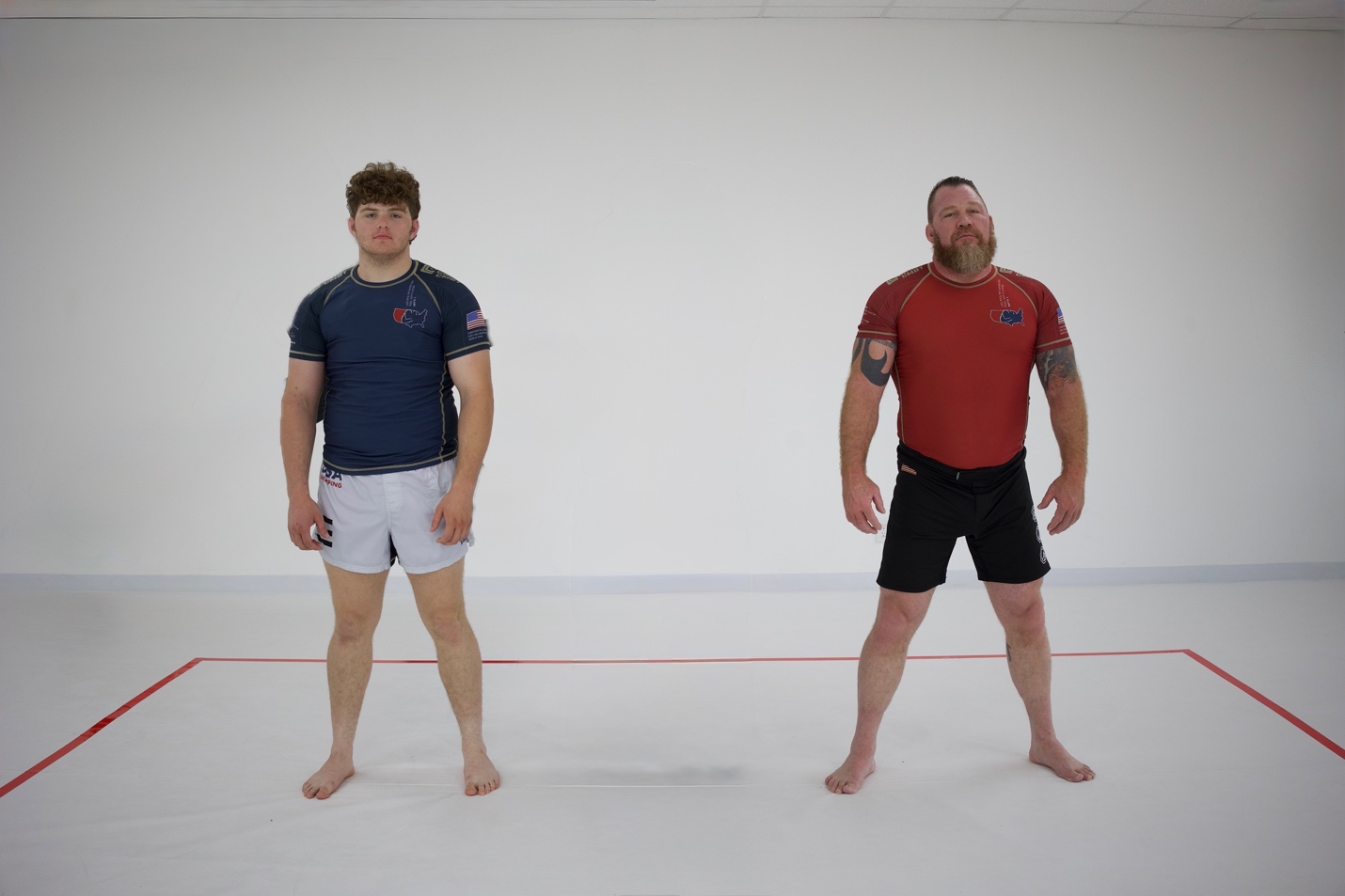
NCGA teams will wear rash guards following the regulations published in section 14 of this rulebook. Teams are required to wear matching rash guards / competition gear / warm-ups in the same round of any NCGA tournament. Matching rash guards / competition gear will be required for duals. Properly placed NCGA Logo must appear on all competition uniforms.

14.1

The NCGA utilizes uniform requirements to help make competition fair and safe for all athletes.

14.2

If a competitor does not meet any of the standards for equipment or uniforms, he/she will be given 5 minutes to change. Failure to meet the requirements for the equipment and uniform standards within those 5 minutes will result in disqualification.

14.3

The competitor must wear undergarments under their shorts due to the risk that the suit might become torn or undone. If shorts are torn, the competitor will be given 5 minutes to find another pair of shorts to wear. If the competitor cannot change within 5 minutes, he/she will be immediately disqualified.

14.4

When the competitor has any part of the uniform ripped during the competition, the referee will allow 5 minutes for a unform change. The competitor must be cleared by the uniform inspector prior to returning to the mat area. If the competitor cannot change within 5 minutes, he/she will be immediately disqualified.

14.5

Competitors must compete in the uniform they wore when they weighed in. Should the competitor weigh in with one uniform and then change into another before their first competition or between their competitions, he/she will be disqualified.

14.6

Wrestling shoes, or any shoes, socks, cups, and headgear are prohibited. Any brace or piece of protective equipment that may alter the outcome of the match may be prohibited. This includes, but is not limited to, braces with metal parts or supports that provide extra grip against the mat. Determination of protective equipment usage shall be determined before the match by the head official

14.7

Uniforms may not have patches and/or text in any form that contain phrases, symbols, or slogans that are offensive to gender, culture, race, sexual orientation, religion, and/or political ideologies or that promote violence, sexual acts, drugs, alcohol and/or tobacco. 

14.8

Competitors are required to wear shoes, sandals, or slippers when off the competition area to avoid feet injury and/or germs on the mat area.

14.9

Female athletes are permitted to cover their heads. The Head Cover requirements are as follows: 

  1. Must be fixed and made with elastic fabric (or have elastics at the borders);

  2. Be made without any kind of plastic or hard materials.

  3. Be made with no strings of any kind.

  4. Be clear of any inscription or logo.

  5. Must be completely in black color.

  6. The head covering can be made of elastic material, must be fully black in color and can cover the neck, ears and hair, like a wetsuit headpiece. The face must remain fully visible.

14.10

Uniform regulations for competition are as follows: 

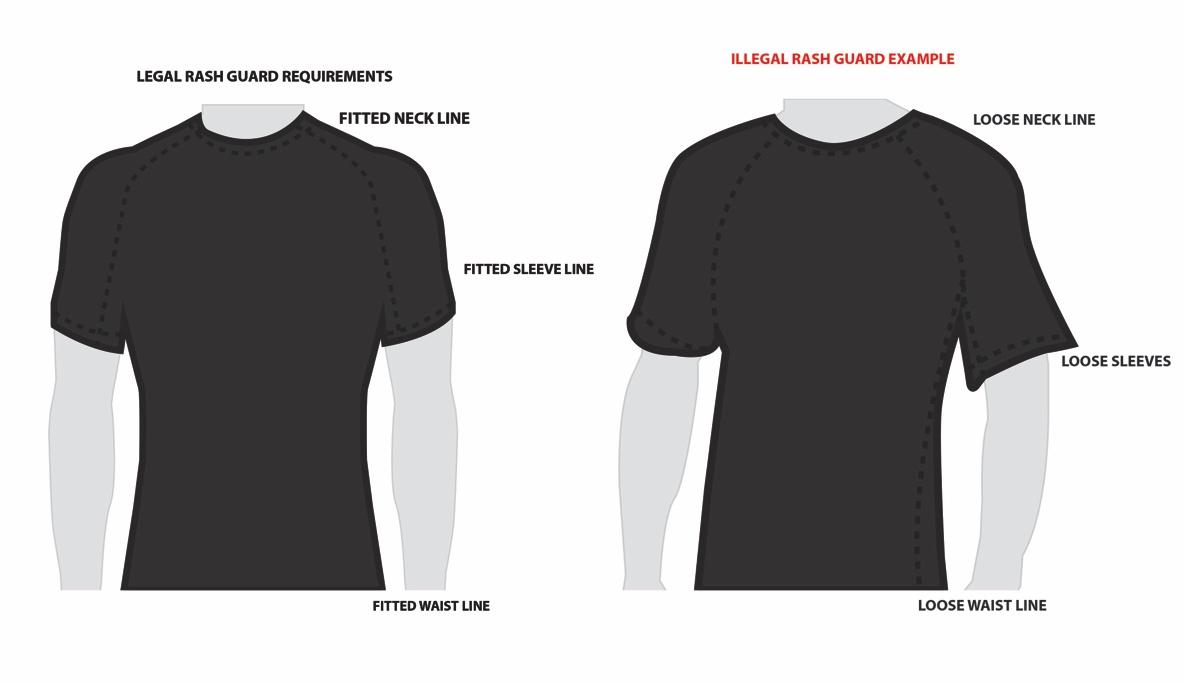
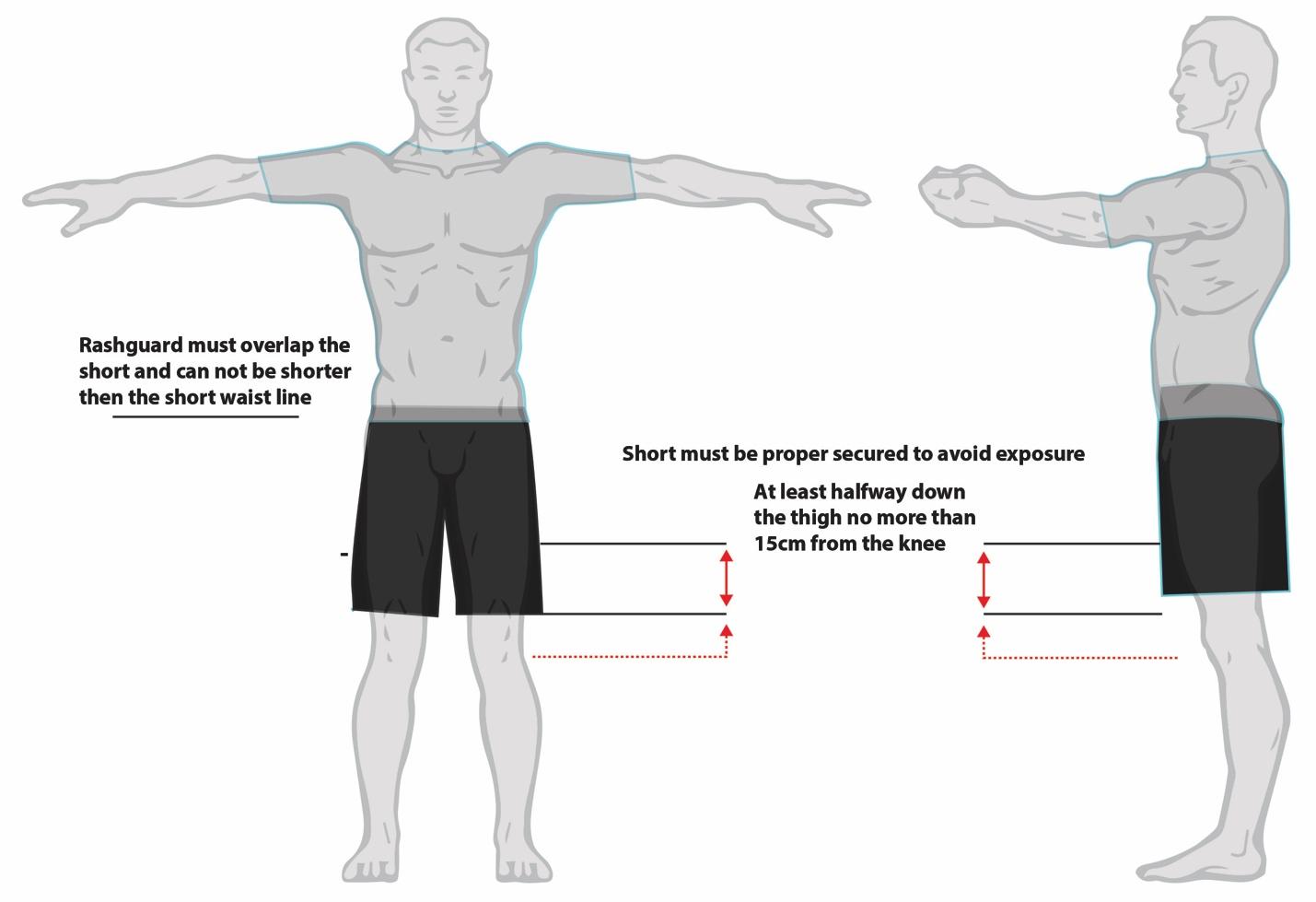
  1. Rash guards must be form-fitting with a round collar (V-necks are not allowed).

  2. Rash guards may have short or long sleeves but cannot be without sleeves.

  3. The shorts must be free of zippers and pockets. 

  4. The shorts must be properly secured to avoid exposure.

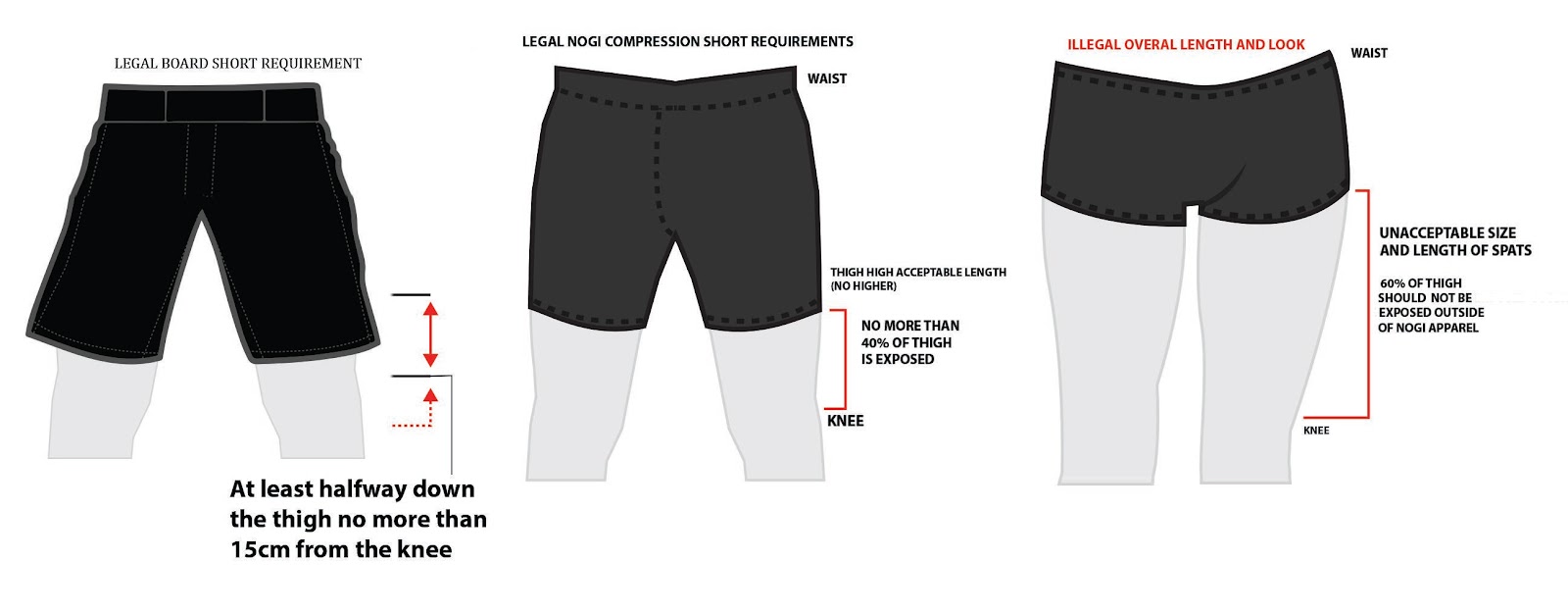
  5. Shorts may be a loose board-like short or tight shorts as long as they are at least mid-thigh length.  

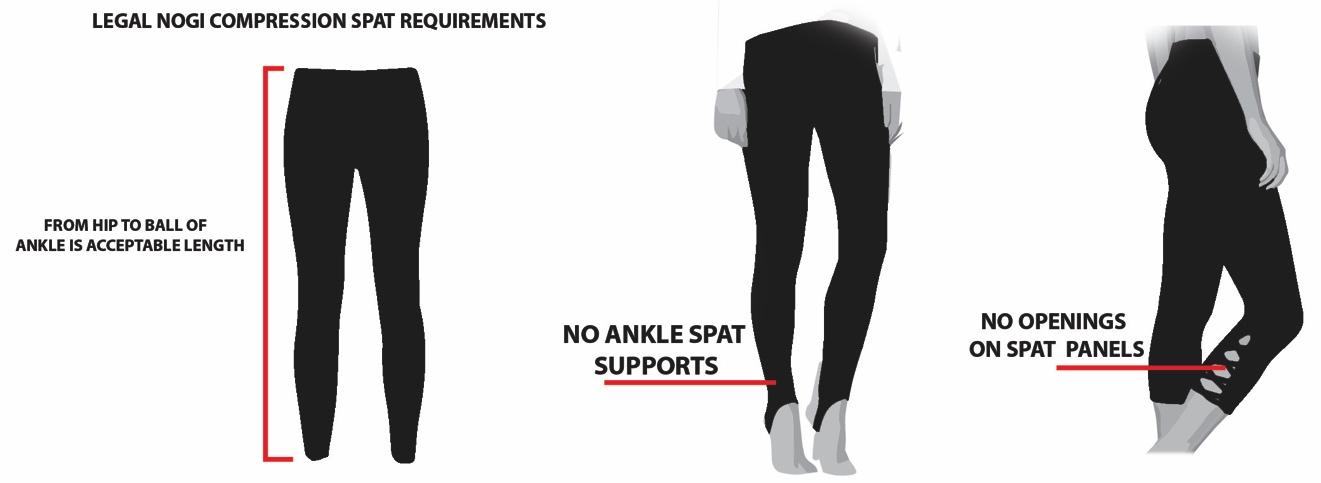
  6. Lycra pants may pass the knee, but not the ankle, and cannot be a loose fit. 

  7. Athletes may choose to compete in shorts or Lycra pants, or both.

  8. The shorts must be tied securely at the waist, above the buttocks. If they are grabbed and pulled down, they should remain affixed where they are secured at the waist.

  9. Athletes are not permitted to compete with torn shorts or torn rash guards. 

  10. Patches and embroidery may be securely affixed in any place on the shorts or rash guard. Any patches with unfixed edges or tears must be removed.


Reporting for Competition

15.1 Weighing In

For every NCGA tournament, athletes must report to the weigh-in area in a timely fashion. Competitors should be dressed in their competition uniform, ready to step on to a calibrated scale, and weighed in at the time their division is scheduled to begin. See Article 6 for additional information on Weight Divisions.

  • For each division, all athletes must be weighed in before the division begins. Athletes will be taken to their weight division’s designated mat area immediately after they weigh in and are expected to be ready to compete immediately after weighing in. Divisions will begin as soon as the final athlete has been weighed in.

  • All athletes must weigh in with their uniform on. Athletes must weigh-in at or below the weight specified for their division or they will be disqualified.

  • The NCGA suggests that athletes do not attempt to “cut weight” by dehydrating themselves before weighing in. Athletes will not be given time to recover or rehydrate after weigh-ins. Athletes should be ready to compete at the time they weigh in. Those who dehydrate themselves are at a heightened risk of fatigue and injury.

  • Failure to appear for weigh-in: Should an athlete fail to appear for weigh-in during the official weigh-in period, it will be noted beside his name on the official weigh-in list. A weigh-in official and the NCGA delegate shall sign the notation and that athlete will be disqualified from competition.

  • Failure to weigh-in within the prescribed limits of a category: Should an athlete weigh above the prescribed limits for the category in which he/she has entered then the exact weight shall be recorded. The weight shall be circled and signed by a weigh-in official and the athlete shall be disqualified from competing in that weight category. 

  • Failure to comply with official directions or with NCGA requirements: If at any stage during the weigh-in period, an athlete fails to comply with the directions of any weigh-in official or an NCGA official, or fails to comply with the requirements of the NCGA, the athlete shall be disqualified from participating in the weigh-in and the infraction brought immediately to the attention of the director of the tournament. 

15.2 Hygiene Requirements

Competitors are expected to meet the following hygiene requirements or they may be disqualified. 

  • Uniform must be washed, dry, and free of unpleasant odor. 

  • Competitor’s toenails and fingernails must be kept short, clean and free from sharp edges or jaggedness. 

  • Individuals with long hair must secure it so that it will not interfere with their performance or that of their opponents during a match.  

  • Competitors may not use makeup, hair spray/dye, or any other substance that will come off onto their own uniform, the mats or onto their opponent. 

  • Any individual with a transmittable disease, viral, bacterial or fungal, will be prohibited from competition. 

  • An individual with an uncovered cut, sore, rash, wound or lesion will be prohibited from competition. Individuals with cuts, sores, rashes, wounds or lesions that are bandaged may be allowed to compete at the discretion of the medic and tournament officials.

15.3

Competitors who are missing from the warm-up or bull pen area, or have already been called to the match area, will be summoned up to three times to report to the specified location. They will have 5 minutes to arrive at the designated area. After the third and final call, if the competitor does not present themselves, they will be subject to disqualification.

VI. Refereeing Body

Refereeing constitutes the highest executive authority within the Organizing Committee of tournaments at any level held under the auspices of NCGA. Respect for referees of all levels is the duty of everyone present at the sporting event: athletes, representatives of sports academies, spectators, and others.

Referee Panel

16.1

The referee panel consists of:

  • the Chief Referee,
  • the Mat Referee

The Chief Referee of the competition holds the highest regulatory authority. Chief Referees are not required for dual meets.

General Duties

17.1

The referee performs all duties prescribed by the NCGA Rules and the specific rules established for the organization of each particular competition.

  1. The task of the referee. is to monitor the progress of each match carefully and evaluate the actions of the athletes so that the results recorded in the referee notes accurately reflect all aspects of the match.
  2. The duties of the referee include all functions related to refereeing and scoring, awarding points, and applying sanctions as provided by the rules.
  3. Referee notes kept by the Table workers are used for the overall assessment of all actions performed by both athletes. Points, warnings, submission holds, and chokeholds must be recorded with high precision in the order corresponding to the different phases of the match. These notes are signed by the Referee.
  4. If a match does not end early due to a submission or chokehold, the final decision shall be made by the Referee. This decision is based on the evaluation of all actions of each athlete, recorded from the beginning to the end in his own notes and in the Table notes.
  5. All points awarded must be immediately announced publicly using illuminated scoreboards, placards, or other similar devices.
  6. Throughout the match, while performing their official duties, members of the referee panel must communicate using the standard grappling terminology; however, they are strictly prohibited from speaking to anyone else during the match and may communicate only among themselves for consultation and to ensure proper execution of their responsibilities.

Referee Attire

18.1

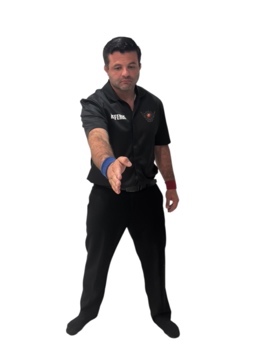
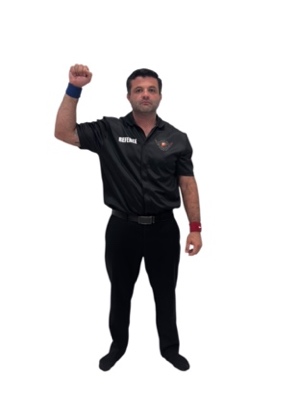
The referee uniform consists of a black polo shirt with official NCGA logos, and black trousers or tights without stripes or other similar decorations.

Referee footwear: black sports shoes with a soft black sole or black socks. Wearing colored shoes or shoes with a hard sole is not permitted.

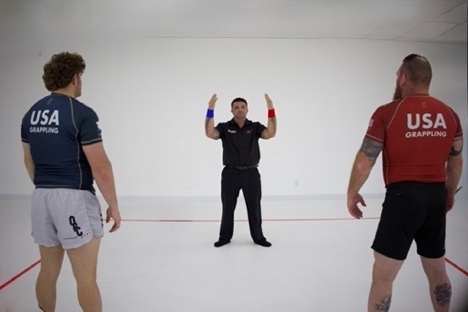
On the mat, referees wear a red wristband on the right wrist and a blue wristband on the left wrist.

Grappling Referee Levels

19.1

Grappling referees are classified into the following certification levels:

  • Class 3
  • Class 2
  • Class 1

The certification level determines the type and level of competitions a referee is authorized to officiate.

19.2 General Requirements for Referees

A referee must:

  • Strictly comply with the rules and requirements of the international federation.
  • Complete the appropriate training and successfully pass the qualification exam.
  • Maintain satisfactory health and meet the established age requirements.

19.3 Certification Level Requirements

Class 3 (Entry Level)

  • Awarded based on the results of the qualification exam.
  • Minimum age: 19 years.
  • Completion of certified referee training courses.
  • Eligible to officiate: Dual Meets and Ranking tournaments

Class 2 (Advanced Level)

  • Awarded based on the results of the qualification exam.
  • Minimum age: 23 years.
  • Must hold Class C certification with at least 2 years of experience at that level.
  • Officiating at a minimum of 6 competitions recognized by the NCGA.
  • Completion of certified advanced referee training courses.
  • Eligible to officiate: Dual Meets, Ranking Tournaments, Regional Championships, National Tournament

Class 1 (Highest Level)

  • Awarded based on the results of the qualification exam.
  • Minimum age: 30 years.
  • Must hold Class B certification with at least 5 years of experience at that level.
  • Officiating at a minimum of 15 competitions recognized by the NCGA.
  • Completion of certified advanced referee training courses.
  • Eligible to officiate: Dual Meets, Ranking Tournaments, Regional Championships, National Tournament

Additional Provisions

  • Further promotion or confirmation of certification shall be conducted in accordance with the procedures established by the NCGA.

Referee Certification Application Process

20.1 General Provisions

  • Candidates must comply with the procedures and requirements established in this guide.
  • National federations of NCGA member countries shall compile and submit to NCGA lists of candidates for referee certification.
  • Assignment of referee classes is carried out within the authority established by this article.

20.2 Qualification Assessment and Class Assignment

Class 3

  • Training, examination, and assignment of Class C are carried out by the NCGA.
  • Information regarding Class C certification is sent to NCGA for registration.

Class 2

  • Training and examination for Class B carried out by the NCGA.
  • The decision to award Class B is approved by the NCGA.

Class 1

  • Qualification, examination, and assignment of Class A are carried out by the NCGA.
  • The decision to award Class B is approved by the NCGA.

20.3 Final Provisions

  • NCGA reserves the right to verify the qualifications of referees of any class.
  • Referee certificates are valid only after registration in the NCGA system.

Qualities of a Referee

21.1

A referee must:

  • Possess strong professional ethics. Referees must strictly adhere to the rules, comply with laws, and maintain discipline. In their officiating duties, they must follow principles of honesty, avoid favoritism, perform their work conscientiously without seeking personal gain, support one another, and cooperate harmoniously. Referees must follow instructions. When interacting with local event staff, referees must respect different customs, cultures, and beliefs. During competitions, they must refrain from commenting on match results or sharing videos unrelated to the competition.
  • Strictly comply with grappling competition rules, correctly understand penalty standards, and scoring criteria. This ensures that athletes compete fairly and under equal conditions.
  • Continuously improve professional competence. Referees must be familiar with and proficient in grappling techniques. They should study new situations and challenges that may arise during matches, continuously enrich their practical experience, and deepen their theoretical knowledge.
  • Maintain impartiality in officiating. On-mat referees must remain completely neutral and avoid unnecessary contact with athletes, coaches, and personnel associated with competing teams.

Referees who fail to properly perform their duties, demonstrate a lack of professionalism, fairness, or impartiality, commit clear violations of rules, issue obviously incorrect decisions, overlook or cancel rulings, or accept bribes, depending on the severity of the situation, may be subject to criticism, retraining, suspension from officiating, demotion, or revocation of referee certification.

Chief Referee

22.1

The Chief Referee of the competition holds the highest regulatory authority. A Chief Referee is not needed for dual meet events. The Chief Referee is responsible for:

22.2 Preparation for the Competition

  • Assuming full responsibility for refereeing during the competition.
  • Understanding and knowing the competition rules, as well as any relevant supplementary provisions.
  • Inspecting the competition venue, equipment, protective gear, and inventory.
  • Clarifying the roles of referees.
  • Preparing the referee work schedule.
  • Checking the preparatory work of each referee.
  • Developing the competition program and work plan.
  • Knowing the rules, conducting referee meetings, organizing referee training on rules, standardizing scoring criteria, and providing clarifications on any complex issues that may arise during the competition.
  • Organizing the draw in a timely manner (once brackets are announced, they cannot be changed).
  • Organizing the weigh-in ceremony.

22.3 During the Competition

  • Leading and supervising the work of each referee.
  • Resolving all issues related to the competition.
  • Making final decisions on technical and procedural matters arising on the mats.

If any referee is found to have violated competition rules or committed a serious misconduct, the Chief Referee has the right to report the incident to the NCGA for the imposition of sanctions.

22.4 After the Competition

  • Conducting a complete referee report and submitting it to the NCGA.
  • Performing a post-competition analysis and providing recommendations to improve refereeing.
  • Preparing and submitting all official protocols to the NCGA.

On-Mat Referee (Mat Referee)

23.1

The Mat Referee is responsible for ensuring that the competition match is conducted in accordance with the provisions of these rules and the competition regulations. The Mat Referee gives commands and instructions that must be followed unconditionally by the participants of the match.

The main duties of the Mat Referee include: starting and ending the match, stopping the match when necessary, returning the athletes to the center of the working area in the same or nearest equivalent position if they leave the competition area, issuing warnings and penalties, awarding points, ensuring athlete safety, and declaring the winner. The Mat Referee must control the conduct of the match and ensure, to the extent possible, that the athletes remain within the competition area.

Specific Duties of the Mat Referee:

  • Signal the athletes to the center of the mat at the start of the match.
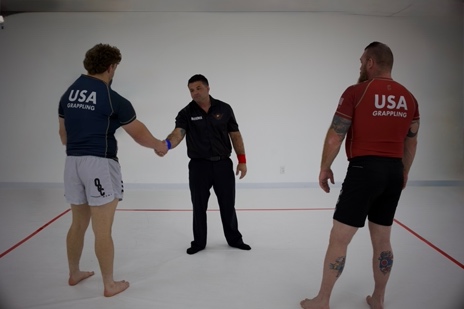
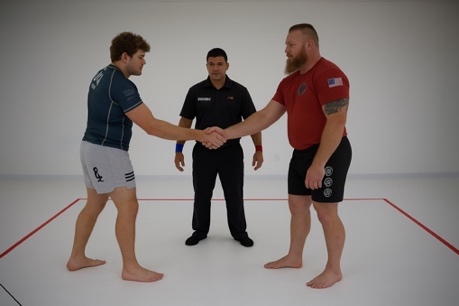
  • Shake hands with the athletes when they enter the mat and before leaving it.
  • Inspect athletes for compliance with the rules regarding appearance and equipment and require them to correct any deficiencies within 2 minutes if present.
  • Inspect the athletes’ skin for sweat or any oily or sticky substances.
  • Avoid standing too close to the athletes during standing exchanges, but remain as close as possible during ground exchanges.
  • Continuously change position on or near the mat, including kneeling or lying prone, to better observe techniques being executed.
  • Never turn their back to the athletes and maintain control of the situation at all times.
  • Verbally encourage passive athletes without stopping the match and issue necessary warnings.
  • Not allow athletes to take a break during the match under the pretext of wiping sweat, blowing their nose, etc.
  • Tug the athlete’s hand or issue a warning if they are holding the opponent’s uniform.
  • Impose penalties for rule violations and unsportsmanlike conduct.
  • Stop the match with the whistle either temporarily or permanently, in the following cases:
    • If both athletes completely leave the competition area, the Mat Referee must stop the match with the command whistle. From the moment the whistle is blown, the athletes must maintain their current position and await the Mat Referee’s instructions. The Mat Referee shall return the athletes to the center of the working area and resume the match in a position as close as possible to the position held at the moment of stoppage, while preserving, to the extent possible, the established control, grips, submission or choke threat, and competitive advantage. If the athletes were standing without any fixed grip or established control at the moment of stoppage, the match shall restart standing, with both athletes facing each other. If one or both athletes had a fixed grip, control, submission or choke threat at the moment of stoppage, the Mat Referee shall restore the athletes to the same or nearest equivalent position in the center of the working area. The match shall resume only on the Mat Referee’s command. Athletes are not allowed to stop or release the position on their own before the Mat Referee’s command. If an athlete stops, releases the position, or disengages without the Mat Referee’s command, and the opponent immediately performs a valid technical action, that action shall be scored in accordance with the rules.
    • Whenever the Mat Referee deems it necessary to stop the match (e.g., to adjust form, issue a scoring decision, or in case of suspected danger or injury).
    • If one or both athletes are injured, lose consciousness, or show signs of illness.
    • In the event of a submission (tapping or verbal).
    • When the match time expires.
  • In all competitions, except the National Championships, the Mat Referee has full authority to stop the match if they believe the athlete is in imminent danger of serious injury..
  • Ensure that athletes remain on the mat until the winner is announced.
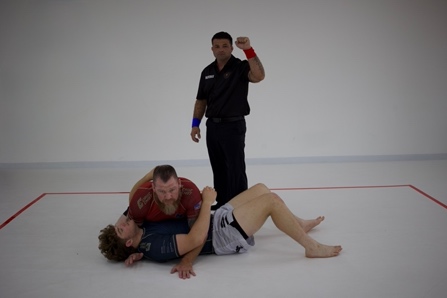
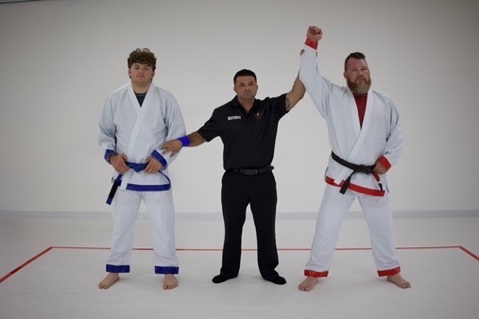
  • Declare the winner by raising the winner’s hand.

Sanctions Applied to Members of the Referee Team

24.1

The NCGA, as the highest authority, may collectively apply the following disciplinary measures to members of the referee team:

  • Issue an official warning to one or more referees;
  • Suspend from officiating at competitions for one or more seasons;
  • Permanently remove from officiating at competitions.

Gestures for Referees

25.1

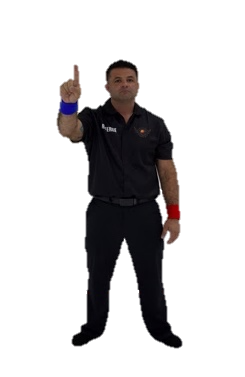
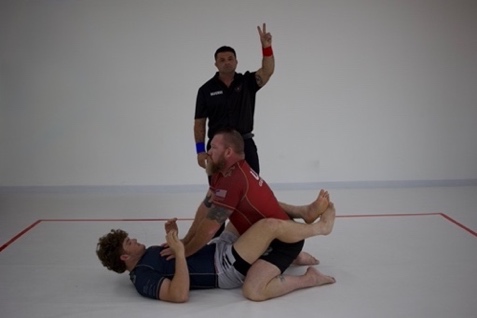
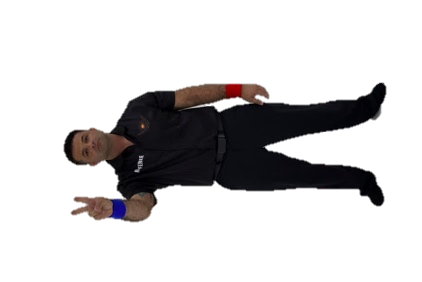
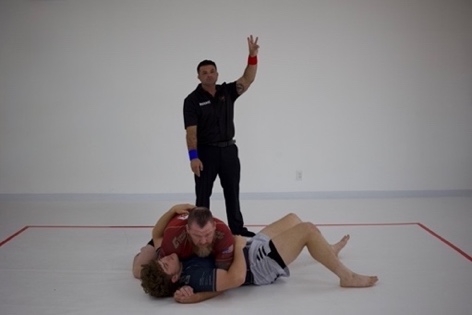
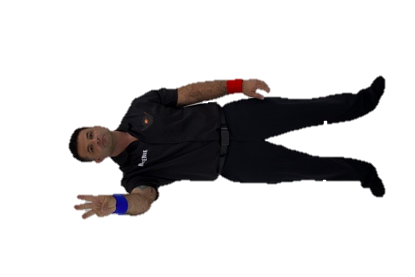
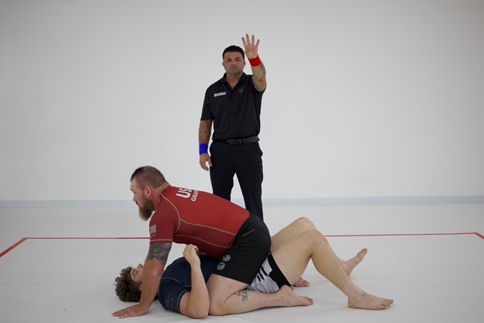
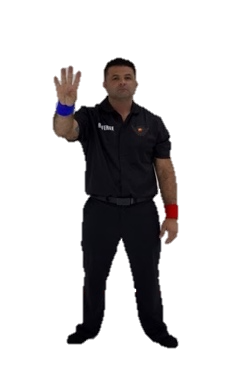
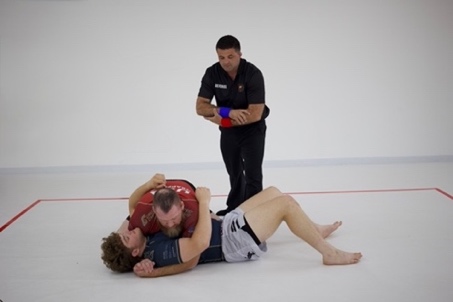
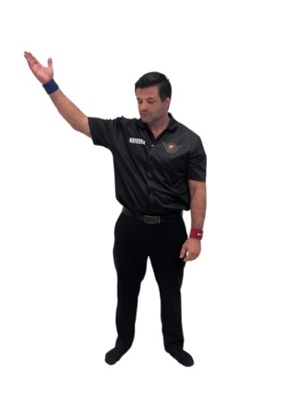
The Mat referee will wear an armband on his right wrist (a red and blue band) to distinguish his hand gestures between competitors. The points indicated with the right hand will correspond to the competitor wearing the red ankle band. The points indicated with the left hand will correspond to the competitor who is not wearing the ankle band. As a match progresses, the referee will raise hand to signal the scoring competitor’s points to the scoring table.

Gesture Description
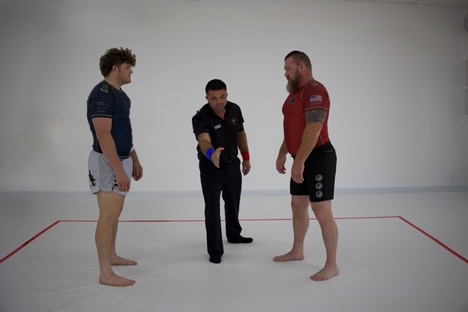
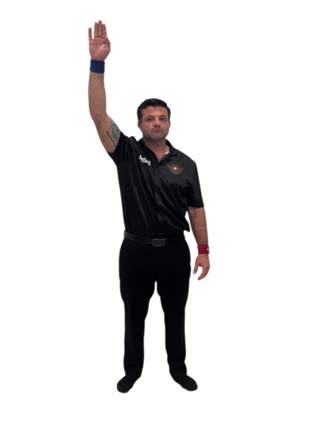
Permission to enter the mat gesture Permission to enter the mat: The referee will raise both arms indicating to both athletes that they should enter the mat area.
Saluting the referee gesture Saluting the referee: Athletes must salute the referee by shaking hands upon entering the mat area.
Shaking competitor’s hand gesture Shaking competitor’s hand: Before and after a match, both competitors must shake each other’s hand regardless of match results.
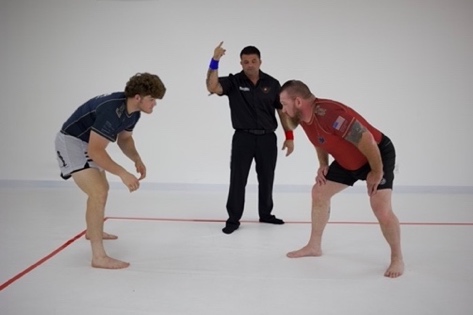
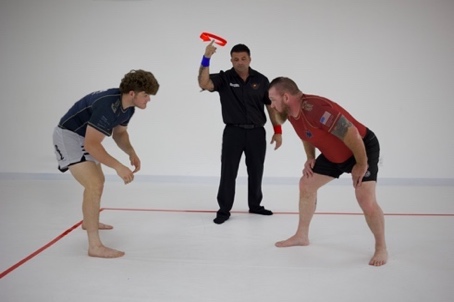
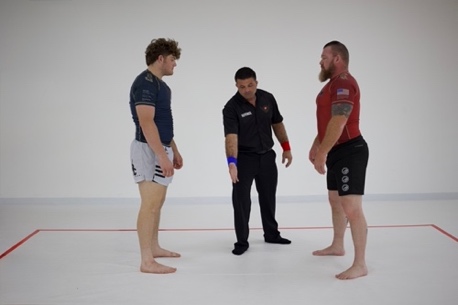
Starting the competition gesture Starting the competition gesture Starting the competition: The referee will position the competitors facing each other in the middle of the mat, the referee will raise his arms at the height of his chest and then let it drop thus signaling the start of the match while blowing their whistle.
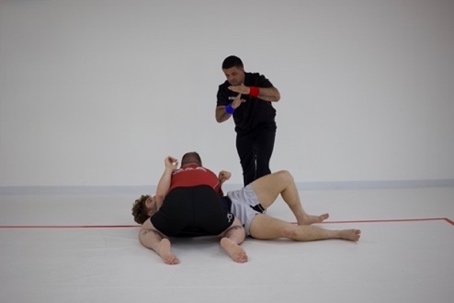
1 Point gesture 1 Point gesture 1 Point: Penalty: The referee will raise his hand indicating the scoring athlete’s color and raise one (1) finger to signify the issue of one point to that athlete’s score.
2 Points gesture 2 Points gesture 2 Points: Take downs, Sweeps, Knee on Belly: The referee will raise his hand indicating the scoring athlete’s color and raise two (2) fingers to signify the issue of two points to that athlete’s score.
3 Points gesture 3 Points gesture 3 Points: Passing the guard: The referee will raise his hand indicating the scoring athlete’s color and raise three (3) fingers to signify the issue of three points to that athlete’s score.
4 Points gesture 4 Points gesture 4 Points: Mount, back with hooks: The referee will raise his hand indicating the scoring athlete’s color and raise four (4) fingers to signify the issue of four points to that athlete’s score.
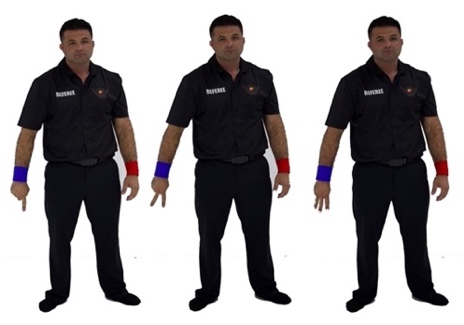
3 Second Count gesture 3 Second Count: The referee will lower his hand which indicates that he has opened the count of three (3) seconds of control prior to awarding points for the following: takedown, sweep, reversal, passing the guard, mount, and back control.
Penalties gesture Penalties gesture Penalties: The referee will turn his hands one over the other with both fists closed then raise a fist indicating the penalized athlete’s color.
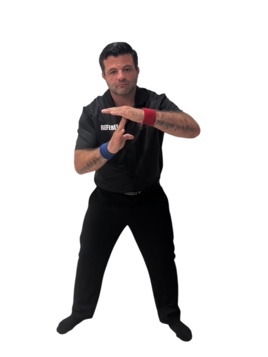
Pausing the match & time gesture Pausing the match & time gesture Pausing the match & time: The referee puts his hands one above the other forming a "T", signaling the timekeeper to pause the time while blowing their whistle.
Stalling gesture Stalling gesture Stalling: The referee will grab each forearm with his hands and verbally warn the competitor who is stalling and first saying “Work to Improve (Red or Blue)” If the competitor does not work to improve then the referee with issues a verbal stalling warning “Warning. Stalling (Red or Blue”
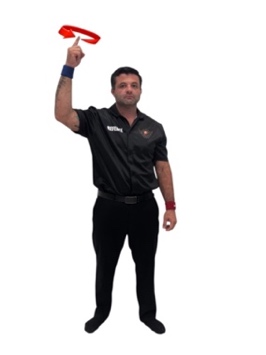
Rotate gesture Rotate gesture Rotate: The referee will raise one finger and rotate it clockwise to indicate to the athletes that they must keep their match within bounds of the mat area.
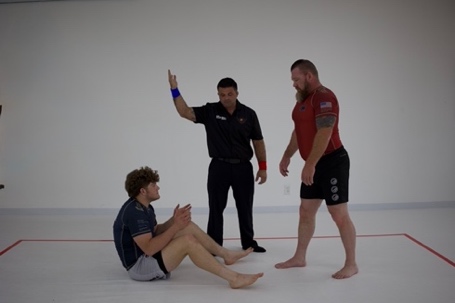
Get up gesture Get up gesture Get up: The referee will raise an arm indicating to the competitor to stand up.
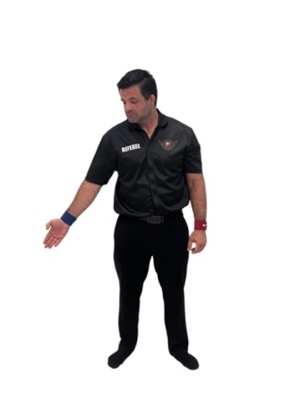
Get down gesture Get down gesture Get down: The referee will lower an arm indicating to the competitor to lie down.
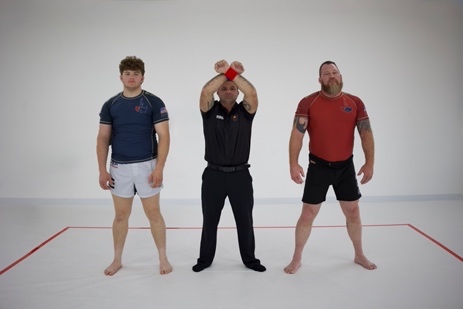
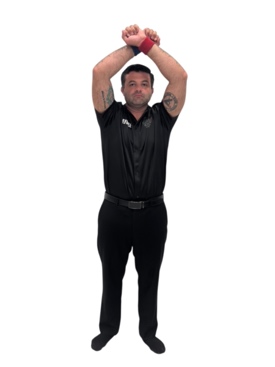
Disqualification gesture Disqualification gesture Disqualification: The referee lifts his arms above his head and cross them with his fists closed. After that, he points to the disqualified athlete with the hand signifying that athlete’s color.
Removing erroneously awarded points gesture Removing erroneously awarded points gesture Removing erroneously awarded points: The referee lifts the arm that he gave the point with and waves his palm towards his head to indicate to the table that previously awarded points were incorrectly awarded and must be removed.
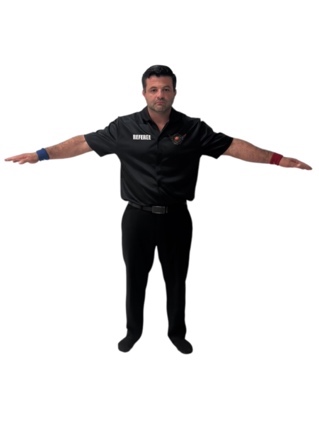
Interrupting the competition gesture Interrupting the competition gesture Interrupting the competition: The referee opens his arms together on a horizontal plane level with his shoulders and blows his whistle or says “Stop!”
Announcing winner of match gesture Announcing winner of match gesture Announcing winner of match: The referee will raise the arm of the winning competitor to indicate who has won the match.

VII. The Match

Duration of the Match

26.1

The duration of a match will be one period of 5 minutes.

The winner is declared by the sum of points scored at the end of the regular time.

The submission automatically stops the match.

A victory by submission (joint lock or choke) automatically ends the match.

The winner is the athlete who forces the opponent to submit or is awarded the victory by points for the majority of rounds.

Call to the Mat

27.1

The athletes are called in a loud and clear voice to present themselves on the mat. An athlete may not be called to compete in a new match until a rest period of twenty (20) minutes has elapsed from the end of the athlete’s preceding match.

A delay is granted to any athlete who does not reply to the first request in the following manner: The athletes must be called three times at 60-second intervals. These calls are made in English. If the athlete does not come forward after the third call, he will be eliminated and will not be placed. His opponent will win the match by forfeit.

Presentation of Athletes

28.1

The following ceremony takes place for each weight category in the finals for first and second places: The finalists are presented and their achievements are announced when they are coming on the mat.

Start

29.1

Before the match begins, each opponent answers when his name is called and takes his place at the corner of the mat assigned to him. The corner is the same color as the Uniform he has been assigned to wear.

The referee, standing in the central circle in the middle of the mat, calls the two athletes to his side. He then shakes hands with them and examines their dress, checks that they are not covered with any greasy or sticky substance, verifies that they are not perspiring, verifies that their hands are bare.

The athletes greet each other and shake hands, and on the referee’s command “fight”, the match begins.

Interrupting the Match

30.1

  1. If an athlete is forced to interrupt the match because of an injury or any other acceptable incident beyond the athlete’s control, the referee may stop the match. During such an interruption, the athletes must sit on the mat on their respective sides. During interruptions, they may not receive advice from their coach.
  2. If a match cannot be resumed for medical reasons, the decision is made by the competition doctor in charge, who informs both the coach of the athlete involved and referee; the latter then orders that the match be stopped. The decision rendered by the competition’s doctor may not be reversed.
  3. If an action must be stopped due to one athlete deliberately injuring his opponent, the athlete at fault will be disqualified.
  4. In case of bleeding of one of the athletes, the referee shall interrupt the match to stop the bleeding. A chronometer will start as soon as the doctor steps on the mat. In case the accumulated time of interruptions to treat the bleeding exceeds 4 minutes over the entire duration of the match, the mat chairman shall order the end of the match. In that case, the athlete concerned loses the match and the opponent wins the match on injury. If the match is grappled until the end, the chronometer will be reset for the next round.
  5. Following medical treatment, the match shall be resumed from the same position in which the athletes were at the time of its stoppage.
  6. If a match is interrupted because of any incident beyond the athletes’ control, the referee may stop the match and the remaining time of the match will be competed as soon as the interruption ends. If a session can’t be concluded in the expected schedule, it may be postponed until the next day. If it is the last competition day and for extraordinary reasons, the end of the competition may be postponed until a later date and take place in another location.
  7. In the event of a serious error not detected by the officiating team (for example, a timekeeper’s error, incorrect points or cautions shown on the scoreboard, an error in resuming the match in the correct ground or standing position, or the declaration of an incorrect winner), the refereeing delegate(s) may intervene and require that the error be corrected through consultation or video review.

End of the Match

31.1

The match ends either when a submission, a disqualification by injury of one of the opponents are declared, or at the end of the regular time.

If the referee has not heard the end of time signal, the table worker must intervene and stop the match. Any action begun at the time when the end of time sounds is not validated and no action performed between the sounds of the gong and the referee’s command «stop» is valid.

When the match has ended, the referee stands in the center of the mat facing the mat chairman’s table. The athletes shake hands, stand on either side of the referee, and await the decision. They are forbidden from removing any part of the uniform before leaving the competition hall. Immediately after the decision is announced, the athletes shake hands with the referee.

Each athlete must then shake hands with his opponent’s coach. If the above provisions are not observed, the athlete at fault will be penalized in accordance with the Disciplinary Regulations.

Interrupting and Continuing the Match

32.1 Procedure for Returning Athletes to Their Original Position After Leaving the Competition Area

If both athletes completely leave the competition area of the mat, the mat referee must stop the bout. From the moment the “stop” command is given, the athletes must maintain their current position and wait for further instructions from the mat referee.

The mat referee shall return the athletes to the center of the competition area and resume the bout in a position as close as possible to the position they occupied at the moment of stoppage, while preserving, to the extent possible, the established control, grips, submission or choke threat, and competitive advantage.

The return shall be carried out according to the following situations:

32.2 Standing Position without Grips

If, at the moment of the “stop” command, both athletes were standing without any established grips, the bout shall resume from a standing position, facing each other, without grips.

32.3 Standing Position with Grips

If one or both athletes were standing with an established grip using one or both hands on the torso, neck, or limbs, they shall be returned to the center of the mat with the grips restored in a position as close as possible to the position that existed at the moment of the “stop” command.

32.4 Transitional Position: Standing → Ground

If the athletes were in the process of transitioning to the ground, the mat referee shall restore a position as close as possible to the phase that had actually been established at the moment of the “stop” command, including body control, leg position, back control, or other relevant positional elements.

32.5 Ground Position with Established Control or Grip

If the athletes were on the ground and one of them had an established control position or fixed grip, including top control, hold-down, back control, guard, half guard, submission hold, choke, or other similar positions, the bout shall resume in a position as close as possible to the position that existed at the moment of stoppage, while preserving, to the extent possible, the grips, control, and competitive advantage.

32.6 Ground Position without Established Grip

If the athletes were on the ground without established control or grips, they shall be returned to the same spatial position — top athlete/bottom athlete — without restoring grips, if no grips existed at the moment of stoppage.

32.7 Submission Hold or Choke

If a submission hold or choke was established at the moment of the “stop” command, the mat referee shall restore a position and configuration of the hold as close as possible to the one that existed at the moment of stoppage, provided that such restoration does not endanger the athletes’ health or safety.

32.8 Disputed or Unstable Positions

If it is objectively impossible to determine or restore a position sufficiently close to the moment of stoppage, the final decision on the form of restart shall be made by the mat referee, guided by safety, fairness, and the preservation of competitive advantage.

Types of Victories

33.1

A match can be won in the following ways:

  • By submission (joint lock or choke)
  • Technical Fall
  • Due to inability to continue
  • After five warnings are given to the opponent
  • By opponent no-show
  • By disqualification
  • By points
  • By criteria

A victory by submission is awarded when the opponent acknowledges defeat, either verbally (by shouting “stop” or “I submit”) or by a physical signal (tapping the opponent or the mat with a hand or foot). Except at the World and Continental Championships in the adult category, the mat referee may award a victory by submission if, upon noticing a submission attempt, he determines that the athlete subjected to the hold cannot escape without injury. Athlete safety must take priority in all situations.

When an athlete concedes the match, either verbally (by shouting or saying “tap” or “stop”) or physically (by tapping the opponent or the mat at least twice with a hand or foot), the opponent is automatically declared the winner, regardless of points scored or match time.

Technical Fall: When there is a difference in score of 15 points.

If an athlete loses consciousness as a result of a legal action applied by the opponent, or due to an accident not caused by any prohibited actions, the mat referee must stop the match, assist the unconscious athlete, and declare the opponent the winner by early victory.

Note: Any athlete who loses consciousness due to a head injury is removed from further competition and referred to medical personnel for assistance.

If, at the end of regulation time, none of the above situations occur, following criteria is used:

  1. The athlete who has the least amount of penalties wins the match.
  2. The athlete with the highest scoring point value wins the match
    • (Example: Red has 4 points [4 Back Control] and Blue has 4 points [2 Takedown, 2 Knee on Belly]. Red wins because his point value for 4 points was greater than Blue.)
  3. Last to Score: The last athlete to score wins the match.

The Coach

34.1

The coach may remain at the foot of the platform or at least two meters from the edge of the mat during the match. If the NCGA doctor (or the competition doctor) allows it, the coach is authorized to assist in the treatment of the injured athlete. Except in this situation and during the break, the coach is strictly forbidden from stepping onto the mat. In that case, the coach may be sanctioned by the referee.

The coach is strictly forbidden to influence decisions or to insult the refereeing body. He may only speak to the athlete. The coach has the right to give water to his athlete only during the break. No other substance may be given during the pause or during the match.

If these restrictions are not observed, the referee is obliged to warn the coach (caution); if he persists, the referee will eliminate him from the competition.

VIII. Points for Actions and Positions

1 point 2 points 3 points 4 points
Penalty Point Takedown Passing the guard Mount
Sweep Reversal/Sweep to Side Mount Back control

All points are awarded based on the elapsed time.

Takedown – 2 points

35.1

A takedown is any transition from standing to the ground resulting from an attacking action, counter-attacking action, scramble, throw, leg attack, trip, counter-action, or any other movement that began from the standing position.

If, during an action that began from standing, a scramble, reversal, or change of initiative occurs, points shall not be awarded to the athlete who initiated the first attack, but to the athlete who ultimately completes the sequence on top and stabilizes control for 3 seconds.

When an athlete takes the opponent down into a turtle position or face-down position, points shall be awarded only if the athlete executing the takedown establishes back control without the need to insert hooks and keeps at least one of the opponent’s knees on the mat for 3 seconds.

If, during the execution of a takedown, transition into a scoring position, or before control is stabilized, the athlete is placed under an immediate threat of a submission or choke, points shall not be awarded until the threat has been eliminated. In such a case, points shall be awarded only after the athlete escapes the threat and stabilizes the corresponding control for no less than 3 seconds.

35.2 Exception — Guard Pull

A guard pull is a conscious and voluntary transition by an athlete from standing into a guard position. A guard pull is considered avoidance of standing engagement.

A voluntary guard pull shall not be scored as a takedown, but shall be penalized by awarding 1 point to the opponent.

Penalties and rules:

  • If an athlete performs a guard pull with a grip and all criteria are met, 1 penalty point will be awarded to the opponent, but the match shall continue from the bottom position.
  • If a guard pull is performed without a grip or with loss of control, for example, if the athlete sits to guard from a distance without engaging the opponent, or if the athlete’s grip is broken, 1 penalty point will be awarded to the opponent and the match shall be restarted from standing.

A detailed description, conditions of application, and penalties are provided in the “Penalties” section.

  • An athlete who initiates a takedown before the opponent begins a guard pull attempt shall be awarded takedown points, provided the control criteria are met.
  • An athlete who initiates a takedown after the opponent has already initiated a guard pull attempt shall not be awarded takedown points, but the opponent shall receive 1 point.
  • If an athlete controls the opponent’s leg and the opponent responds by pulling the athlete into guard, the athlete controlling the leg shall be awarded 2 points for the takedown, provided top control is stabilized.
  • If an athlete controls the opponent’s leg and the opponent jumps to closed guard and remains suspended in the air, the athlete must bring the opponent’s back to the mat and then stabilize the top position for 3 seconds in order to receive takedown points.

35.3 Transition from Ground to Standing and Takedown Scoring

During a sweep attempt, if both athletes remain standing for less than 3 seconds and the athlete playing guard takes the opponent back down onto the back, side, or into a kneeling position with back control, takedown points shall not be awarded.

In any position that begins from the ground with frontal contact between the athletes, chest-to-chest or face-to-face, if the athletes are in a position considered standing for 3 seconds, the situation shall thereafter be considered standing engagement.

Note: for the 3-second count to begin, one athlete must be standing with both feet on the mat, while the opponent must have at least one foot on the mat, with the knee of the opposite leg not touching the mat.

For points to be awarded again, the situation must return to a position considered standing: both of the athlete’s knees must be lifted off the mat, and the feet must remain on the mat for no less than 3 seconds. Before this time has elapsed, any continuation of the action shall be considered part of the previous ground or transitional sequence.

Points shall not be awarded for taking the opponent down from a kneeling position if that position arose from guard, turtle, scramble, or any other ground-fighting situation, except in cases of a continuous standing sequence or sweep defense, as separately described in these Rules.

From a turtle position or face-down position, points may be awarded again only after a new action. For this to occur, the athletes must be in a position considered standing: both knees of the bottom athlete must be lifted off the mat, and the feet must remain on the ground/tatami for no less than 3 seconds. One or both hands may remain on the mat.

After that, either athlete who subsequently takes the opponent down and establishes control may be awarded takedown points.

Sweep – 2 Points

36.1

A sweep is a technique in which an athlete in the bottom position on the ground, while engaged frontally with the opponent — chest-to-chest or face-to-face — initiates a reversal or change of position, ends up on top, and establishes top control for 3 seconds.

If, after the sweep, the opponent ends up in a turtle position or face-down position, points shall be awarded only if back control is established and at least one of the opponent’s knees is kept on the mat for 3 seconds. The insertion of hooks is not required.

Points for a sweep shall not be awarded if the athlete in the bottom position ends up on top as a result of an attack initiated by the opponent.

  • If an athlete initiates a submission while on top, whether from mount, side control, guard, or another position, but during the execution of the submission ends up in the bottom position, the opponent shall not be awarded sweep points.
  • If an athlete in the bottom position initiates a sweep, and the top athlete begins attacking a submission during the action, the athlete who initiated the sweep shall be awarded points only after escaping the submission hold and maintaining the top position for 3 seconds.
  • If the athlete on top voluntarily moves to the bottom position without a real attack on a submission or choke, and the opponent immediately, within 3 seconds, takes the top position and maintains control for no less than 3 seconds, this shall be considered a successful sweep, and 2 points shall be awarded.

Sweep points shall be awarded only if taking the top position is the result of a continuous attacking action initiated from the bottom position. If the action was stopped and neutralized, or lost its continuity for 3 seconds or more before top control was established, sweep points shall not be awarded. However, temporary neutralization of the position by the opponent shall not, by itself, interrupt the sweep attempt if the attacking athlete continues, without stopping, to develop the original movement and fight to complete the sweep. In such a case, if the attacking athlete ends up on top as a result of this continuous attempt and establishes top control for 3 seconds, sweep points shall be awarded.

Example 1: If an athlete attempts a sweep from the bottom position and the opponent loses balance, causing the opponent’s hips to touch the mat, but during the transition the attacking athlete, instead of completing the sweep, switches to a leg submission attack, while both athletes remain in a neutral position for more than 3 seconds, and only afterward the attacking athlete completes the movement and ends up on top, sweep points shall not be awarded.

Example 2: An athlete attempts a sweep from the bottom position. The opponent defends, loses balance, and in an attempt to defend the sweep temporarily neutralizes the position; however, the attacking athlete continues, without stopping, to develop the same sweep attempt and ultimately ends up on top, establishing top control for 3 seconds. In this case, sweep points shall be awarded.

36.2 Reversals

Reversals shall be scored as sweeps only if they meet the criteria of a sweep.

For points to be awarded, the action must:

  • begin from the bottom position on the ground with frontal engagement between the athletes — face-to-face, chest-to-chest, or from a guard position;
  • be initiated by the athlete in the bottom position, and not occur because the athlete ended up on top after defending a submission;
  • be performed without stopping, neutralization, or loss of continuity for 3 seconds or more;
  • end with the athlete coming on top and establishing top control for no less than 3 seconds.

If the action does not meet the above criteria, sweep points shall not be awarded.
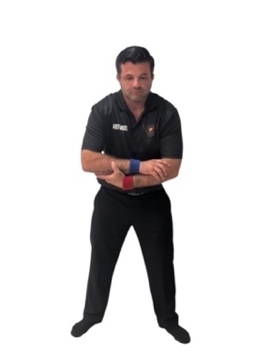
Reversal to Side Mount – 2 Points

37.1

If the bottom athlete sweeps or reverses the top opponent and lands directly in side mount 3 points will be awarded

Guard Pass – 3 Points

38.1

Definition of the Guard Position

The guard position is a position in which the athlete on the bottom uses one or both legs to control the opponent and block them from establishing a dominant position.

A guard pass is a technical action in which the athlete in the top position bypasses the legs and hips of a lying or seated opponent. The athlete must move past the opponent’s hip line into a position such as side control, north-south, mount, or knee on belly, while pinning the majority of the opponent’s back to the tatami and maintaining control for 3 seconds.

If the attacking athlete, while passing the guard, is unable to secure the opponent in such a way that the majority of the opponent’s back is pinned to the ground for 3 seconds, the athlete shall not be awarded points for the guard pass.

Reversal to Side Mount Control - 3 Points

Mount - 4 Points

40.1

Mount points shall be awarded when an athlete controls the opponent from the top, facing the opponent’s head and positioned on the opponent’s torso, with both of the athlete’s knees touching the mat on either side of the opponent’s body.

The position must be stabilized for no less than 3 seconds.

Note: the mount position shall also be considered established if one of the opponent’s arms is trapped under one knee, or if both of the opponent’s arms are trapped under both knees of the athlete controlling the top position, provided that control is maintained for no less than 3 seconds.

Back control – 4 Points

41.1

Back control is a dominant position in which an athlete is positioned behind the opponent and controls the opponent’s torso using two hooks or a body triangle.

The position is considered established when the athlete controls the opponent’s back, while the athlete’s legs may trap one or both of the opponent’s arms, but not above the opponent’s shoulder line.

For points to be awarded, the athlete must maintain back control for no less than 3 seconds.

Scoring Principles for Positions and Technical Actions

42.1

Points may be awarded again for the same position only after a transition to another position, or after the opponent has fully escaped the previously established control for 3 seconds or more, followed by a new stabilization of the position for no less than 3 seconds.

A change of variation within the same position shall not be considered a new stabilization and shall not result in additional points.

Points for any scoring technical action or position shall not be awarded if, during the execution of the action, transition into the position, or before control is stabilized, the athlete is placed under an immediate threat of a submission or choke. In such a case, points shall be awarded only after the threat has been eliminated and the corresponding control has been stabilized for no less than 3 seconds.

Athletes shall be awarded cumulative points when they transition consecutively through several scoring positions, provided that the 3-second positional control in the final scoring position is a continuation of positional control from the previous scoring positions in that sequence.

In such a case, the referee shall count only 3 seconds of control at the end of the sequence, after which the referee shall signal the points for the entire sequence.

Example: a guard pass followed by mount shall be scored cumulatively as 7 points: 3 + 4. A sweep followed by control in mount shall be scored cumulatively as 6 points: 2 + 4.

Team Scoring

43.1

Submission / Disqualification / Default = 20 pts.

Forfeit = 20 pts

Cumulative Points = The sum of every team member’s points scored during their matches will be totaled and applied to total team points. This will include the points scored by a grappler who achieved a submission.

Team Scoring Tie Break

44.1

In the event of a tie the following criteria will be applied.
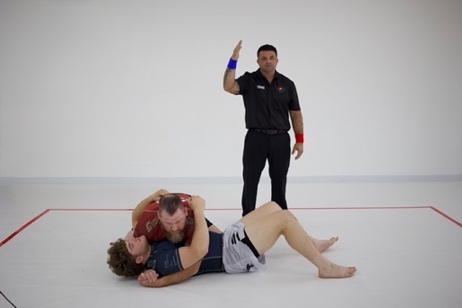
  1. Most submission victories.
  2. Most competitor victories.

IX. Penalties, Fouls, and Prohibited Actions

Serious Disciplinary Violations

45.1

Serious disciplinary violations shall be punished by automatic disqualification. Athletes who, in the referee’s opinion, commit a serious disciplinary violation shall be automatically disqualified without discussion.

  • The use of profanity or obscene gestures by an athlete toward the opponent, the table officials, officials, referees, or spectators before, during, or after the match.
  • The demonstration of hostile behavior by an athlete toward the opponent, the table officials, officials, the referee, or spectators before, during, or after the match.
  • If a competitor expresses disrespect toward the opponent or spectators verbally or through gestures during the match or during the celebration of victory.
  • If two athletes are found to have participated in a fixed match, both athletes shall be disqualified.
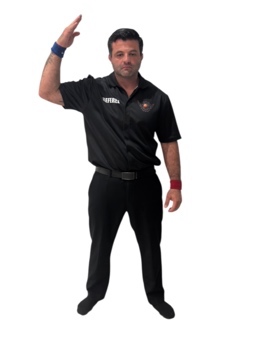
Technical Violations

46.1

This section outlines the list of prohibited actions, fouls, and restrictions, as well as the corresponding penalties.
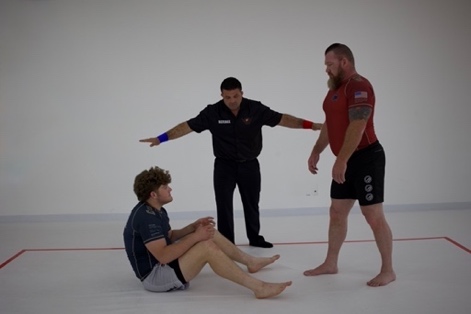
Minor Prohibited Actions and Penalties

47.1 General Provisions

Minor prohibited actions shall be penalized by penalties that result in negative points or disqualification.

Penalty Sequence

For a rule violation, penalties shall be assigned to the competitor in the following sequence:

First penalty —1 point awarded to the opponent

Second penalty — 1 point awarded to the opponent

Third penalty — 1 point awarded to the opponent

Fourth penalty point — disqualification

47.2 Procedure for Recording a Violation

If the referee observes a violation, the referee shall indicate the athlete who is being penalized by raising a clenched fist to shoulder level, using the arm with the wristband corresponding to the color of the penalized athlete’s corner: when penalizing the athlete from the red corner, the referee raises the arm with the red wristband; when penalizing the athlete from the blue corner, the referee raises the arm with the blue wristband.

After assigning a penalty point (1) to an athlete opponent, the referee must notify the athlete and/or the athlete’s coach.

After an athlete receives the first penalty point, verbal warnings shall no longer be applied, and any subsequent violations shall immediately result in the next point (1) being awarded to the opponent.

The following actions are considered minor prohibited actions.

Minor Prohibited Actions Resulting in 1 Point to the opponent

48.1

  • Placing a hand or foot on the opponent’s face.
  • Grabbing one’s own or the opponent’s uniform in any manner.
  • Poking the opponent’s face or eyes with the fingers.
  • Intentionally delaying the match due to unprepared equipment or frequent and prolonged adjustment of equipment.
  • Grabbing individual fingers or toes: fewer than four fingers on the hand or fewer than five toes on the foot.
  • Talking to, commenting to, or exchanging gestures with outside persons, except when requesting medical assistance.
  • Ignoring commands or showing disrespect toward the referee’s instructions.
  • Arguing or disputing with anyone in the competition area.
  • Talking or shouting during the match.
  • Faking an injury.

Passivity or Avoidance of Engagement

49.1

Passivity is defined as the absence of an athlete’s intent to progress in the match, improve position, perform attacking actions, or return to active engagement, as well as actions aimed solely at preventing the opponent’s progress.

Note:.An athlete who is defending against a submission or choke shall not be penalized for passivity.

If the referee determines that one or both athletes are being passive in the standing position or on the ground, the referee shall give the command “Action” and begin a 20-second count.

If, during this time, the athlete does not demonstrate activity, an attempt to improve position, escape control, attack, or create real progress, the athlete’s opponent shall receive one point.

In the case of passivity by both athletes, a penalty point shall be assigned to each athlete.

Systematic retreating, avoiding contact, refusing to engage grips, as well as refusing to continue fighting after escaping the opponent’s control, shall be considered passivity or avoidance of engagement. In such cases, the referee may give the athlete one verbal warning without a mandatory 20-second count. If such behavior is repeated, the athlete shall be penalized with a penalty point being awarded to the opponent for avoidance of engagement.

Exiting the Competition Area

50.1

If an athlete avoids engagement by stepping out of the mat area or intentionally pushes the opponent out of bounds without performing a technical action, the referee issues a verbal warning. For a repeated violation, the athlete is assigned a penalty and one point is awarded to the opponent.

If an athlete, while technically attempting to escape a submission or choke, exits the competition area more than once, they receive a penalty one point is awarded to the opponent.

In the case of a deliberate exit from the mat during the execution of a submission or choke, the athlete is subject to disqualification.

Intentional Transition to Guard Position (Guard Pull)

51.1

Guard pull is a conscious, voluntary transition of a competitor from standing to the guard position.

Possible grips during guard pull:

  • Neck grip (collar tie, front head control);
  • Arm grip (one or both arms);
  • Body grip (body lock, overhook/underhook);
  • Leg grip (single leg, ankle control, etc.);
  • Combined grips (arm + neck, body + leg, etc.).

Grip criteria:

  • A grip is considered established if the athlete has clear controlled contact with the opponent’s body, allowing influence over their balance or position.
  • The grip must be established before the hips or back touch the mat.
  • Brief contact without control does not count as a grip.
  • The final decision on the presence of a grip is made by the referee on the mat.

Penalties and rules:

  • If an athlete performs a guard pull with a grip and all criteria are met → a penalty point is assigned, but the athlete continues fighting from the bottom.
  • If a guard pull is performed without a grip or with loss of control (e.g., sitting into guard from a distance without gripping the opponent) → the athlete receives a penalty point and is returned to standing.
  • If both athletes are in the standing position and one of them places one or both knees on the mat for more than 3 seconds without technical engagement with the opponent, that athlete shall receive a penalty point of 1 in accordance with the guard pull rules.

Special situations:

  • If the athlete maintains a submission (guillotine, footlock, etc.) → the 3-second count does not start until control is lost.
  • After loss of control → the standard 3-second count begins.

Double Guard Pull

52.1

A double guard pull is a situation in which both athletes simultaneously or almost simultaneously, within 3 seconds, initiate a transition to the bottom position without establishing top control.

Scoring Rules

  • If, after going down, both athletes remain on the bottom for more than 3 seconds, both athletes shall receive a penalty point.
  • If one athlete manages to stand up within 3 seconds and take the top position:
  • the athlete who stood up shall not receive a penalty;
  • the athlete who remained on the bottom will receive a penalty with one point being awarded to the opponent.

Special situation: if, after a double guard pull, an athlete maintains a submission hold or is actively working on the ground, the 3-second count shall not begin while control is maintained. After control is lost, the standard 3-second count shall begin, and a penalty point may be assigned to the opponent.

Jumping into Guard

53.1

Jumping into guard or attempting a submission in a jump while the opponent is standing is prohibited.

If violated, the referee stops the bout, assigns a penalty point (−1) to the athlete, and restarts the match in the center of the mat in a standing position.

If the action causes injury to the opponent, the offender is disqualified.

Equipment Non-Compliance

54.1

If an athlete’s uniform does not meet the established requirements, they are given up to 2 (two) minutes to correct the violation.

If the time limit is exceeded by less than 1 minute — a penalty point (1) is assigned to the opponent.
If the exceedance is 1 minute or more — the athlete is disqualified.

Serious Prohibited Actions

55.1

Serious prohibited actions shall be punished by automatic disqualification. Competitors who commit serious prohibited actions observed by the referee shall be automatically disqualified without discussion.

  • Performing any action with an obvious intent to injure the opponent.
  • Intentionally applying pressure to the opponent’s eyes with the fingers.
  • Intentionally striking with the hands, feet, knees, forearms, elbows, or head.
  • Intentionally biting, pulling the hair, nose, or ears, or striking the groin.
  • Intentionally provoking a reaction from the opponent that causes the opponent to enter a prohibited position resulting in disqualification.
  • Using any slippery or moisturizing substances, including creams, oils, or ointments.
  • Falling onto a grounded opponent from a standing position.
  • If a competitor applies a technique that is prohibited in the category in which the competitor is competing, according to the table of permitted and prohibited techniques, and the opponent submits or is injured, the competitor shall be disqualified.
  • Intentionally exiting the competition area during a submission or choke.
  • Pulling individual fingers or toes, fewer than four fingers on the hand or fewer than five toes on the foot, in order to escape while the opponent is applying a submission or choke

X. Table of Allowed and Prohibited Techniques

NCGA Techniques
1 Leg stretch submission – banana split
2 Front choke with spinal pressure using a triangle with the legs
3 Ezekiel choke
4 Straight foot lock
5 Front choke – Guillotine (arm in, arm out guillotine)
6 Shoulder lock with leg (Omoplata variations)
7 Pulling the opponent’s head toward oneself with the hands while applying a triangle choke
8 Arm triangle variations (Arm Triangle, Anaconda, D’arce, Peruvian Necktie)
9 Buggy choke
10 x Blocking the opponent’s airflow to the nose or mouth using the palms (muffler)
11 Reverse rear naked choke applying pressure to the neck
12 rib and kidney compression from closed guard
13 Wrist locks
14 Bicep slicer
15 Calf slicer
16 Knee bar
17 Toe hold
18 Knee reaping during a leg lock
19 x Scissor takedown
20 x Heel hook
21 x Aoki Lock
22 x Outside Toe Hold
23 x Slam
24 x It is prohibited to apply a guillotine choke across the face with a twisting force on the chin.
25 x It is not allowed to roll forward while the opponent is in back control.
26 x Throws from standing that cause the opponent to land on the head or neck.
27 x Applying submission techniques to individual fingers (fewer than four) or toes (fewer than five).
28 x Neck Cranks (including Twister, Crucifix neck crank, Full Nelson, Can Opener, and all variations and similar mechanics)
29 x Choking with the fingers by compressing the throat or trachea.

XI. Safety Regulations & Special Conditions

Medical Timeouts and Injury Procedures

56.1 Medical Timeouts

  1. Bleeding: If a competitor begins bleeding during a match the referee will immediately stop the time, separate the competitors, place the non-injured competitor on his knees to wait, and signal to a medic to assist the bleeding competitor. Once the bleeding is under control, the match may continue. Guidelines for bleeding are as follows:
    • The Medic may treat the same bleeding injury on two (2) occasions. The third (3rd) time that the same bleeding injury occurs, the Referee shall end the contest for the athlete’s own safety and shall declare the opponent to be the victor.
    • At the discretion of the referee and the medic, the match may be stopped if the cut or bleeding is too severe and cannot be contained with the appropriate dressing or tape.
    • Blood must be cleaned immediately from uniforms and mat surfaces. The medical personnel must then clean the surface with chloride type germicidal.
  2. Injuries: If a competitor complains of an injury during a match, the referee will stop the match and call the medic to attend to the injured competitor. It is important to note that this may be considered the same as verbally tapping out to a submission. Guidelines for injuries are as follows:
    • The Medic may declare that the injured competitor can continue without danger to their health, and if agreed by the Referee the match continues.
    • The Medic may declare that the injured competitor cannot continue because their health is in danger. The Referee may declare the injured competitor the loser if the injury was the result of an act that would not have resulted in a penalty for the attacking competitor (must be able to continue within 1 minute) or the Referee may declare the injured competitor the winner if the injury was of a prohibited act outlined in this rulebook.
    • The Medic may declare that the injured competitor cannot continue as a result of an attack and of a pre-existing condition (i.e. asthma, physical ailment). The Referee may declare the injured competitor the loser if the injury was the result of an act that would not have resulted in a penalty for the attacking competitor (must be able to continue within 1 minute).
    • If both competitors are injured and cannot continue the match, the athlete leading on the scorecard shall be declared the winner. If the score is tied and both cannot continue, then the referee must render a decision based on fighting spirit, superiority of tactics, and superiority of techniques. In all other situations, both competitors will be disqualified from continuing since they cannot continue to compete.
    • If it is impossible to determine which of the competitors was the cause of the injury, the athlete unable to continue shall lose the match.
  3. Sickness: If a competitor becomes ill during a match and cannot continue then the opponent will be awarded the victory.
  4. Accident: If an accident occurs due to an unforeseeable event or an outside influence, the match will be cancelled or postponed. In the event of this occurrence the Referee Director will make the final decision.

56.2 Severe Impact to the Head or Back

The Referee shall call the Medic to attend to an athlete who has received a severe impact to the head or back (spinal column), or whenever the Referee has reason to believe there may be a grave or serious injury. In either case, the Medic will examine the athlete in the shortest time possible and indicate to the Referee whether the athlete can continue or not. Referees will determine match results in accordance with the guidelines identified in Article 56.1.b.

56.3 Concussions

A concussion is typically defined as a head injury with a temporary loss of brain function. Symptoms include a variety of physical, cognitive, and emotional symptoms, which may not be recognized if subtle. Fewer than 10% of sports-related concussions are associated with loss of consciousness.

A variety of signs accompany concussion including consciousness or amnesia), behavioral changes (such as irritability), cognitive impairment (such as slowed reaction times), or sleep disturbances. It is imperative in the event of a suspected concussion that the appropriate steps be taken to preserve the athlete’s health as well as to ensure an appropriate medical follow up. Safety guidelines for suspected concussions are as follows:

  1. The Referee shall stop the match immediately.
  2. The Referee will call the event Medic immediately to examine the athlete. The Medic will make the decision as to whether the athlete has potentially suffered a concussion and cannot continue.
  3. The athlete should respect the recommended rest period prescribed by the Medic and/or Medical Doctor.
  4. The athlete should officially inform the NCGA Medical Commission of injury.
  5. The athlete should return to activity only when medical clearance has been granted.

56.4 Medical Suspension Following Concussion

Athletes who have a confirmed concussion following an assessment by a Medical Doctor, or by a the event’s head of medical services, are not allowed to compete within a period of seven (7) days starting the day after the date of injury. Athletes can return to competition only after obtaining a medical clearing from their team medical doctor, family doctor, or any other medical doctor having the authority to issue such a clearing.

Visually or Physically Impaired Competitors

57.1

A visually challenged competitor will have the right to choose to start the match with a grip or a touch. If an athlete has a disability affecting the leg or foot may choose to start match in the sitting position. All other physically impaired competitors will begin a match traditionally.

XII. Review, Appeals & Oversight

Video Review

58.1 Referee Video Review

  1. When there is no significant action, the referee may stop the match to conduct a video review of a grappling sequence if:
    1. There is reasonable certainty an error was made regarding timing, scoring or the proper positioning of the grapplers.
    2. the situation is reviewable; or
    3. The outcome of a review may have an impact on the result of the match
  2. Referee video reviews shall occur before any coach-requested video review is executed There is no restriction on the number of times a referee may stop the match for a review and there is no time limit to conduct a review, but the referee(s) should strive for each review to be efficient and timely When a third-party reviewer is utilized for coaches’ video review challenges, the reviewer may consult the referee only to obtain pertinent information (e.g. time, score) for review.

Coach’s Video Review Challenge

59.1

  1. Each team is allowed one challenge per dual meet b When video review is used for an entire individual-team advancement tournament, the number of video reviews by each team is restricted to:
    1. 1-3 participants in the tournament — 1 video review
    2. 4-6 participants in the tournament — 2 video reviews
    3. 7-10 participants in the tournament — 3 video reviews
  2. If video review is not being used for the entire individual-advancement tournament, tournament committees may determine the number of coach’s video review challenges as long as it does not exceed the current allotment
  3. If a coach would like to execute a video review challenge, the coach shall immediately throw the foam brick into the competition circle, which indicates their intent to challenge a call on the mat The referee has sole authority to determine if the review was requested in a timely manner The only time a coach may retract a video review challenge is when the call on the mat is changed by the referee When a coach challenge is requested, the referee will stop the match as quickly as possible, but only when no significant action is taking place
  4. Once the match is stopped, the coach shall explain to the referee and/ or third-party reviewer what is being challenged The challenged error, indicated by the coach, establishes the starting point for the challenge sequence.
  5. If the coach and the referee request/elect to execute a video review at the same time, the referee review shall always occur first.
  6. If the call questioned by the challenging coach is overturned, the institution is not charged with a video review If the call questioned by the challenging coach stands/is confirmed, the institution is charged a video review challenge Any/all other corrections made during the challenged sequence will not result in either coach being charged with using a video review challenge.
  7. If the referee determines the coach delayed throwing the foam brick, the video review challenge shall not be allowed, and the coach will lose the video review challenge.
  8. If a coach challenges a previously made ruling on a video review challenge or if a coach challenges a ruling when the team’s allotment of video review challenges has been exhausted, the actions are considered intentional delay of the match and the coach is penalized with a control of mat violation.
  9. If a coach requests a video review of a submission, which is not reviewable, the coach shall be charged with a video review challenge.

Coach’s Video Review Completion

60.1

After the referee completes the review, or is informed by the third-party reviewer of the outcome, the referee should make one of the following announcements:

  1. If the video evidence confirms the on-the-mat ruling: “After further review of the coach challenge, the ruling on the mat stands”
  2. If the on-the-mat ruling is changed: “After further review of the coach challenge, the ruling on the mat is changed”
  3. If corrections unrelated to the initial coach challenge were made, the referee should announce those changes publicly at the conclusion of either announcement.

60.2 System or Operator Failure/Error

If there is no video evidence due to a system failure or operator error, the coach will retain the challenge If the video review system fails, no challenges shall be permitted for the remainder of the individual match being contested.

60.3 Obstructions

Any obstruction of the view on the video screen caused by participants, coaches, referee(s) or tournament personnel on the mat during any part of the challenged sequence that does not allow for a confirmed ruling by the referee shall result in the challenging coach retaining their video challenge.

Questions about officials?Contact Art

Art BarkerPresident & Director of the NCGA Officials Association

Call Art Email Art